
Buy Guide
Large Dog Kennel Size Chart 2026: Find the Right Fit
Sep
Large Dog Kennel Size Chart 2026: Find the Right Fit
A large dog kennel is an enclosure built for dogs roughly 50 pounds and heavier, typically at least 6 feet tall and offering a minimum of 12 square feet of floor space for a single dog. The sizing rule is simple: measure your dog from nose to tail base, add 6 inches, and square that number.
Most people buying a large dog kennel start with the product photo and work backwards. That is how you end up with a 6 × 4 run that a German Shepherd can barely turn around in, or a kennel tall enough for a Great Dane but too narrow for a bed and a water bowl at the same time. The numbers below come from the same formula federal animal-care regulators use, so you can size a kennel against your actual dog instead of a marketing label.
The Sizing Formula Regulators Actually Use
The most dependable starting point is not a retailer’s size table. It is the minimum space rule from the Animal Welfare Act, published by the USDA’s Animal and Plant Health Inspection Service (APHIS) in its Animal Care Tech Note, Minimum Space Requirements for Dogs.
Here is the formula in full: measure your dog’s length in inches from the tip of the nose to the base of the tail while your dog is standing in a normal position. Add 6 inches. Multiply that total by itself. Divide by 144 to convert square inches into square feet. A Labrador that measures 31 inches from nose to tail base needs (31 + 6) × (31 + 6) ÷ 144, which works out to about 9.5 square feet of floor space.
Height follows a separate rule in the same document: the interior height of the enclosure must be at least 6 inches above the head of the tallest dog inside, measured while that dog stands comfortably in a normal position. A Great Dane whose head sits 34 inches off the ground at a normal stand therefore needs a ceiling no lower than 40 inches above the floor — and in practice you want considerably more.
Quotable: “Minimum kennel floor space equals the dog’s body length plus 6 inches, squared, then divided by 144 — the calculation published by the USDA’s APHIS Animal Care program to satisfy the Animal Welfare Act.”
Large Dog Kennel Size Chart by Body Length
Rather than estimate, measure. Stand your dog against a wall in a normal position, mark the floor at the nose and at the base of the tail, and measure between the marks. Then read across this table, which uses the APHIS quick-reference values.
| Body length (nose to tail base) | Minimum floor space | Breeds commonly in this range |
|---|---|---|
| 30 inches | 9.0 sq ft | Border Collie, Australian Shepherd |
| 33 inches | 10.6 sq ft | Boxer, Siberian Husky |
| 37 inches | 12.8 sq ft | Labrador Retriever, Golden Retriever |
| 40 inches | 14.7 sq ft | German Shepherd, Rottweiler |
| 44 inches | 17.4 sq ft | Bernese Mountain Dog, Leonberger |
| 48 inches | 20.3 sq ft | Great Dane, English Mastiff |
| 52 inches | 23.4 sq ft | Irish Wolfhound, Newfoundland |
Breed pairings are approximate guideposts only. Individual dogs vary widely within a breed, and a lean field-line Labrador can measure several inches shorter than a bench-bred one, so always size against the dog in front of you.
Standard Kennel Footprints and What They Actually Fit
Once you know the square footage your dog needs, match it to a footprint. These are the sizes you will see most often in large-breed kennels, with the honest capacity for each.
| Footprint | Floor area | Realistic fit |
|---|---|---|
| 4 × 4 ft | 16 sq ft | One large dog up to about a 44-inch body length |
| 6 × 4 ft | 24 sq ft | One large dog with room for a bed and bowls |
| 8 × 4 ft | 32 sq ft | One large dog comfortably, or two medium dogs |
| 8 × 8 ft | 64 sq ft | Two large dogs without crowding each other |
| 10 × 10 ft | 100 sq ft | Two to three large dogs with genuine running room |
The jump from 4 × 4 to 8 × 4 doubles your floor area for roughly double the price, and it is the single upgrade most large-breed owners regret skipping. A dog that cannot take a full stride turns a kennel into a stall.
Floor Space Is Not Exercise Space
APHIS draws a distinction that catches a lot of buyers out. The minimum floor space calculation sets the enclosure size. The exercise requirement is a separate figure, and for a singly housed dog it is double the minimum floor space requirement (9 CFR 3.8). The Labrador needing 9.5 square feet of floor space to lie down and turn around needs roughly 19 square feet of room to move.
Quotable: “For a singly housed dog, the Animal Welfare Act exercise requirement is twice the minimum floor space calculation — so a dog needing 12.8 square feet of floor space needs about 25.6 square feet of exercise area.”
That is the argument for treating a large dog kennel as a base station rather than a full-time home. Pair it with a pen or open-yard time, and the enclosure size becomes a comfort question instead of a welfare one.
Height and Escape Risk
Panel height is where most large-dog escapes are decided. A 4-foot enclosure is a hurdle for a motivated Husky and a minor inconvenience for a Malinois. For unsupervised time, look for panel height at or above 6 feet; a 5-foot panel works only for calmer, older dogs, and anything under 5 feet is a poor bet for a large breed left alone.
Height is also a heat and airflow variable. A taller kennel with a full roof traps less hot air in summer, which matters if the structure sits in direct afternoon sun. If your dog will spend real time out there in July, pair the kennel with a shaded dog house — our guide to insulating a dog house covers the cold-weather half of that problem.
How to Size a Large Dog Kennel: Step by Step
- Measure body length. Stand your dog normally against a wall and measure from nose tip to tail base. Do not wrap the tape around the body’s contours.
- Add 6 inches and square it. Multiply the result by itself, then divide by 144 to get square feet.
- Double it for exercise. If the kennel is the dog’s only outlet for movement, compare the result against your chosen footprint and size up if needed.
- Measure standing head height, then add 6 inches. That is your absolute minimum interior ceiling. Add another 6 to 12 inches for comfort and air circulation.
- Check the gate and latch. A single slide latch is not enough for a strong, clever dog. Look for a two-action latch or carabiner-compatible hardware.
- Budget for a floor. Almost no welded-wire kennel includes one. A gravel pad, rubber mat, or concrete slab keeps the dog off mud and stops digging escapes.
Materials: What Separates a Keeper from a Cart-Replacer
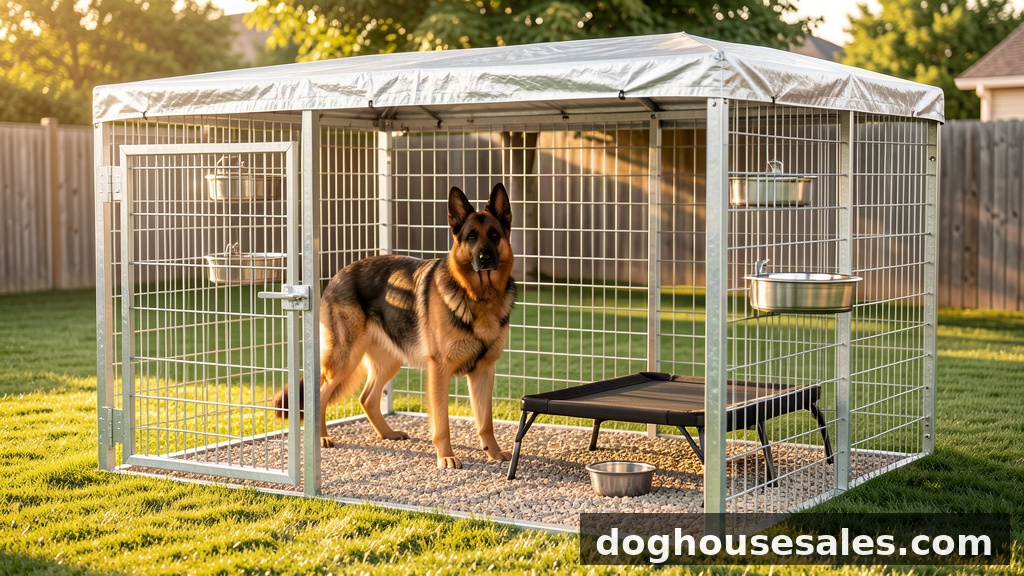
Two numbers tell you more than any marketing badge. First, the frame tube: look for galvanized or powder-coated steel tube at 19 mm or thicker with a wall around 1 mm — that is the specification on the heavier-duty 8 × 4 × 6 ft kennels sold as large-breed runs, which weigh in around 100 pounds. Second, the mesh: fully welded wire at roughly 3.3 mm diameter resists leaning and pawing far better than chain link or snap-together plastic panels.
If a listing shows plastic corner brackets instead of bolts or clamps, treat it as a kennel for a dog under 40 pounds regardless of what the size label claims. For a worked example of a large-breed unit that meets these thresholds, this 8 × 4 × 6 ft welded wire large dog kennel with roof cover lists a 102-pound assembled weight, 19 mm square steel tube, and 3.3 mm welded mesh. Prices and availability change constantly on Amazon, so confirm the current figures on the listing before you buy.
For a deeper materials breakdown, our heavy duty dog kennel buying guide covers rust treatment, roof coverings, and ground anchoring in detail, and if you are choosing between welded steel runs we compare the leading options in our picks for large and strong dogs.
Kennel, Dog House, or Playpen?
These three products get confused constantly, and the sizing maths differs for each.
- A kennel is a roofed outdoor run — steel frame, welded or chain-link mesh, walk-in height. Size it with the APHIS formula above.
- A dog house is an enclosed shelter the dog sleeps in, not a containment structure. Sizing is about height clearance and interior volume, not exercise space — see how to determine the perfect dog house size.
- A playpen is a portable, unroofed panel enclosure for supervised or indoor use. Our panel play yard guide covers the modular versions.
Many large-breed owners end up with two products: a dog house for sleeping and shade, and a kennel or pen for containment. If your dog is indoors most of the time, start with the sizing logic in our medium dog house buying guide and scale the numbers up for a larger breed.
Frequently Asked Questions
How big should a kennel be for a large dog?
Measure your dog from nose to tail base, add 6 inches, square that number, and divide by 144. A Labrador measuring 37 inches needs roughly 12.8 square feet of floor space. Add headroom of at least 6 inches above standing head height, and double the floor figure if the kennel is the dog’s only exercise outlet.
Is a 4 × 4 kennel big enough for a large dog?
A 4 × 4 footprint gives 16 square feet, which satisfies the minimum for a dog up to about a 44-inch body length. It is adequate as a sleeping and resting station, but it is tight for all-day containment. An 8 × 4 footprint doubles the area for roughly double the cost.
What height kennel do I need for a large breed?
Six feet of panel height is the practical standard for large, athletic breeds left unsupervised. Five feet works for calm or older dogs, and anything under five feet carries a real risk of a large dog going over the top. Interior ceiling height must also clear the dog’s standing head by at least 6 inches.
Do I need a kennel floor?
Most welded-wire kennels ship without one. A gravel pad, rubber mat, or concrete slab keeps the dog out of mud, reduces digging escapes, and is markedly easier to clean. Concrete suits large breeds best because it does not shift under a heavy dog’s weight.
Kennel or dog house — which does a large dog need?
They solve different problems. A kennel provides secure containment and exercise room; a dog house provides insulated shelter for sleeping and escaping heat or cold. Many large-breed owners use both, placing the dog house inside or beside the kennel.
The Bottom Line
Size a large dog kennel with arithmetic, not optimism. Measure nose to tail base, add 6 inches, square it, and divide by 144 for the floor area. Clear standing head height by 6 inches for the ceiling. Then double the floor figure if the kennel has to serve as your dog’s main exercise space as well as its shelter.
Get those three numbers right and the rest of the decision — steel gauge, latch type, roof cover, floor surface — becomes a straightforward comparison instead of a gamble.
Questions about sizing or corrections to anything in this guide? Email support@doghousesales.com and we reply within one business day. Last updated: September 2026.
{ “@context”: “https://schema.org”, “@type”: “HowTo”, “name”: “How to Size a Large Dog Kennel”, “description”: “Measure your dog, calculate the minimum floor space with the APHIS formula, and verify height, latch, and floor requirements before buying a large dog kennel.”, “totalTime”: “PT20M”, “step”: [ { “@type”: “HowToStep”, “position”: 1, “name”: “Measure body length”, “text”: “Stand your dog normally against a wall and measure in inches from the tip of the nose to the base of the tail. Do not follow the contours of the body.” }, { “@type”: “HowToStep”, “position”: 2, “name”: “Calculate minimum floor space”, “text”: “Add 6 inches to the measured body length, multiply that total by itself, then divide by 144 to convert square inches into square feet. A 31-inch dog needs about 9.5 square feet.” }, { “@type”: “HowToStep”, “position”: 3, “name”: “Double the figure for exercise space”, “text”: “If the kennel is the dog’s only outlet for movement, double the minimum floor space, per the Animal Welfare Act exercise requirement at 9 CFR 3.8. Compare that total against the kennel footprint and size up if it falls short.” }, { “@type”: “HowToStep”, “position”: 4, “name”: “Verify interior height”, “text”: “Measure the dog’s standing head height and add at least 6 inches for the absolute minimum ceiling. Add another 6 to 12 inches for comfort and summer air circulation.” }, { “@type”: “HowToStep”, “position”: 5, “name”: “Check the gate and latch”, “text”: “Choose a kennel with a two-action latch or carabiner-compatible hardware. A single slide latch is not sufficient for a strong or escape-prone large dog.” }, { “@type”: “HowToStep”, “position”: 6, “name”: “Plan for a floor surface”, “text”: “Most welded-wire kennels ship without a floor. Add a gravel pad, rubber mat, or concrete slab to keep the dog out of mud and to reduce digging escapes.” } ] }