
Buy Guide
Medium Dog House Buying Guide: Sizes, Materials & Picks
Sep
Medium Dog House Buying Guide: Sizes, Materials & Picks
A medium dog house is a shelter sized for dogs that weigh roughly 25 to 50 pounds, with an interior floor long enough for the dog to lie flat and a doorway at least three-quarters of its standing height. Most medium models measure 28 to 44 inches long and 22 to 34 inches tall.
If your Beagle, Cocker Spaniel, or Border Collie would rather sleep on the back step than go inside its shelter, the problem is usually sizing, not price. The label on the box says “medium,” but medium covers a wide spread of body shapes, and a stocky Bulldog and a leggy Border Collie can weigh the same and still need very different doorways. This guide covers how to measure your dog, which material survives your climate, and three medium dog house options we checked on Amazon in September 2026. If you would rather work backwards from your dog’s measurements, our dog house size guide walks through the full chart.
What Size Is a Medium Dog House?
There is no industry standard for the word “medium,” so the fastest way to compare products is to use a manufacturer that publishes weight ranges. Petmate’s Indigo Igloo lists its medium dog house at 37.5 by 30.5 by 22.75 inches for dogs weighing 25 to 50 pounds, then jumps to 43.75 inches for the large (50 to 90 pounds) and 50.5 inches for the extra large (90 to 125 pounds) [source: Petmate product page, checked September 2026].
That 25-to-50-pound band is the working definition most brands use, and it lines up with what breed-size guides call a standard medium dog. What it does not tell you is whether your particular dog will fit. As one sizing guide puts it, weight alone does not show how much interior space a house needs — a 35-pound Bulldog and a 35-pound Border Collie have different height, length, and doorway requirements [source: PetsCosset medium dog house sizing guide].
| Body type | Typical weight | What usually goes wrong | What to prioritize |
|---|---|---|---|
| Compact and stocky (Bulldog, French Bulldog, Corgi) | 20-35 lbs | Shoulders catch in a narrow doorway | Wider entry, sturdy floor, extra side clearance |
| Balanced medium (Beagle, Cocker Spaniel, Shiba Inu) | 25-35 lbs | House fits, but the dog can’t turn around | Moderate height, width, and length together |
| Tall and leggy (Border Collie, Australian Shepherd) | 35-50 lbs | Head or back touches the roof inside | Taller interior and a longer floor |
| Medium-large (Boxer mix, larger Collie) | 45-60 lbs | Everything is tight, dog paces outside instead | Size up to a large house |
Body-type categories and weight bands adapted from PetsCosset’s medium dog house sizing breakdown. Treat the weight column as a starting point, not a rule.
How to Measure Your Dog for a Medium Dog House
Three measurements decide the purchase. Measure from the front of the chest to the base of the tail for body length, from the floor to the top of the head or ears for standing height, and across the widest part of the shoulders or chest for width [source: PetsCosset]. Then apply the fit rules below rather than matching the numbers exactly.
| Measurement | Rule of thumb | Why it matters |
|---|---|---|
| Interior floor length | Dog’s lying nose-to-rump length plus 6 to 8 inches | Room to stretch out flat, not curl in a ball |
| Interior height | A couple of inches above the dog’s seated height | Stand and turn without ducking |
| Doorway height | At least three-quarters of standing height | Easy entry while still holding warmth in |
| Doorway width | Wider than the widest part of the chest or shoulders | Stocky breeds otherwise squeeze through |
Doorway and ceiling rules are from a pre-built dog house buyer’s guide that specifies a door of at least three-quarters of standing height and a ceiling a couple of inches above the seated height. A separate kennel-buying guide gives the simpler version: the shelter should be about 3 to 4 inches taller and 3 to 4 inches longer than the dog [source: Petmania kennel sizing guide].
One caution on trusting the label: several owners report that the Petmate Indigo runs small in practice. In a long-form owner review, a 21-inch-tall Labrador fit the large Indigo’s opening comfortably while an 85-pound German Shepherd mix could not fit at all — and both dogs were lean, not overweight [source: Zen and the Art of Dog, Indigo review]. If your dog sits at the top of a weight band, size up.
Wood, Plastic, or Insulated: Which Material Holds Up
Material choice is really a question about your climate and your dog’s mouth. Wood insulates naturally and looks like garden furniture, but it needs maintenance. Plastic is light, waterproof, and easy to hose out, but it provides less insulation. Resin and composite sit in between: weatherproof and long-lived, at a higher upfront cost [source: material comparison, RoofHousePedia].
| Material | Insulation | Chew resistance | Upkeep | Best for |
|---|---|---|---|---|
| Solid fir wood | Good (thick panels) | Good, better with a metal frame | Re-seal annually, keep dry | Cold winters, front-yard looks |
| Foam-insulated wood | Best (foam core between wood skins) | Moderate to high | Keep the liner and floor dry | Below-freezing nights |
| Heavy plastic (igloo) | Moderate (double wall traps air) | Very high | Hose down, no tools | Chewers, mild climates, quick cleaning |
| Resin or composite | Moderate | High | Hose down | Wet, coastal climates |
On the insulation side, there are three approaches worth knowing. Foam board or foam bead inside the walls delivers the best R-value per inch and shows up in brands like Aivituvin. Double-wall plastic construction, which is what the Petmate Indigo uses, traps a layer of air that buffers temperature swings. Reflective foil liners bounce radiant heat back toward the dog. For extreme cold, foam wins; for moderate climates, double-wall plastic is plenty and far easier to clean [source: insulated dog house material review, TheBrickFantastic].
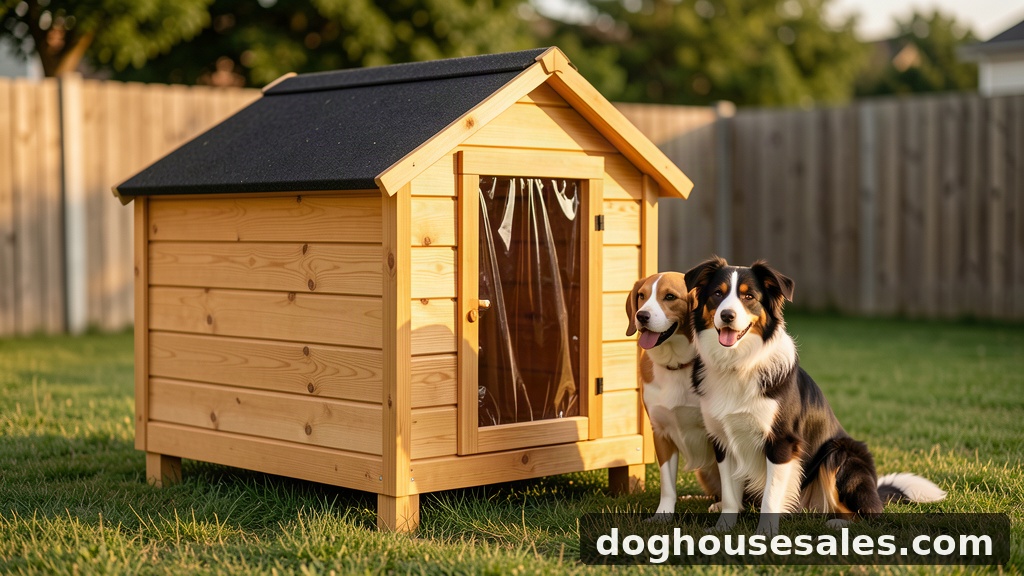
The foam-built medium dog house below is the one to look at if your dog spends real hours outside in winter. Its walls are a sandwich: fir wood outside, a foam core, and a plywood inner skin, with a clear PVC door flap that snaps shut behind the dog instead of leaving an open hole. As the reviewers put it, a house can be perfectly insulated and still run cold if the doorway is a wide-open hole, so the flap matters as much as the foam [source: mylittleandlarge insulated wooden dog house review, June 2026].
Budget context: most quality wooden dog houses land somewhere between roughly $90 and $370, with single-dog models at the low end and reinforced double-dog builds at the top [source: wood vs plastic dog house comparison, PetsCosset]. All three picks below sit inside that range.
Features Worth Paying For
Once the size fits, a handful of design details separate a house your dog uses from one that becomes a spider hotel:
- Raised floor. Ground moisture is the main cause of a damp, smelly dog house. The Petmate Indigo uses a raised floor with side moats that drain water away from the sleeping surface [source: Petmate product page].
- Sloped or asphalt roof. Asphalt sheds rain and won’t rot; a hinged or openable roof makes cleaning a two-minute job instead of a wrestling match.
- Ventilation that can close. Rooftop vents circulate air in summer but should be closable or adjustable for winter. Look for adjustable vent windows.
- A PVC or vinyl door flap. Keeps wind and rain out while still letting the dog push through.
- Reinforced edges. A metal frame around the panels is the difference between a house that survives a bored dog and one that doesn’t. Panel thickness matters too — 0.47-inch panels are noticeably stiffer than the 0.35-inch panels used on cheaper builds.
- Removable floor and pre-drilled holes. Assembly should be a screwdriver job, and the floor should lift out for hosing.
If you want a deeper look at wood construction specifically, our guide to the best wood dog house options covers joinery, finishes, and which woods hold up outdoors.
Top Medium Dog House Picks for 2026
All three products below were checked directly on Amazon in September 2026 for price, stock, and specifications. Prices move with color and availability, so treat them as a snapshot.
Best overall for medium and large dogs: Gowoodhut 43.7″ Wooden Dog House
This is the roomiest wooden option in the medium bracket and the one with the clearest published specs. It measures 29.5 by 43.7 by 33.7 inches, uses 100% solid fir wood with an asphalt roof and a PVC door curtain, and lists a 270-pound floor capacity. The door opening is 12.5 by 21.9 inches and the floor area is 7.1 square feet, which is enough for a Border Collie or Husky to stand, turn, and lie flat. Panels are 0.47-inch thick, and the manufacturer rates it for medium and large breeds with a one-year warranty. Assembly is required and takes a screwdriver and pre-drilled holes.
Check the Gowoodhut 43.7″ Wooden Dog House on Amazon
Best for cold weather: 43.3″ 6-Side Insulated Wooden Dog House
Foam-core insulation on all six sides makes this the pick for dogs that are outside in winter rather than just outside on nice days. It measures 43.3 by 26.4 by 29.5 inches with a 14.7 by 15.2-inch doorway, an asphalt hinged roof, a removable floor, and a stated 220-pound load capacity. The narrower footprint than the Gowoodhut makes it a better fit for a patio or a balcony. It was listed at $169.99 at the time of writing, in stock.
Check the 43.3″ 6-Side Insulated Dog House on Amazon
Best plastic option: Petmate Indigo Igloo Dog House, Medium
The classic igloo is still the fastest option to live with: tool-free snap assembly, a smooth surface you can hose down, and no wood to reseal. The medium is 37.5 by 30.5 by 22.8 inches and rated for 25 to 50 pounds, with an offset doorway that blocks wind and rain, a vented roof, a raised floor with side moats, and 90% recycled materials made in the USA. It was listed at $139.99 at the time of writing. Remember the sizing caveat above — owners of 45-50 pound dogs often go up to the large.
Check the Petmate Indigo Igloo Dog House (Medium) on Amazon
| Pick | Exterior size (in) | Material | Stated capacity | Listed price |
|---|---|---|---|---|
| Gowoodhut 43.7″ | 43.7 L x 29.5 W x 33.7 H | Solid fir wood, asphalt roof | 270 lb floor load | Check listing |
| 6-Side Insulated 43.3″ | 43.3 L x 26.4 W x 29.5 H | Foam-insulated wood | 220 lb load | $169.99 |
| Petmate Indigo Medium | 37.5 L x 30.5 W x 22.8 H | Double-wall plastic | 25-50 lb dog weight | $139.99 |
Still working out whether you want the shelter inside or out? Our breakdown of indoor dog house dimensions covers the interior-placement version of the same sizing math.
How to Set Up a Medium Dog House
- Pick the spot before you assemble. A shaded, elevated patch of ground on the north or east side of the house beats full sun. Leave the doorway facing away from prevailing wind and rain.
- Level the ground. Set the house on a flat paver pad or a bed of compacted gravel. A house that rocks will get avoided, and standing water under the floor is what rots wooden bases.
- Raise the floor off the ground. If the shelter does not have built-in raised feet, add a pressure-treated pallet or two concrete pavers underneath. Airflow under the floor is the cheapest comfort upgrade you can make.
- Seal the doorway against wind. Fit the PVC or vinyl flap it came with, or add aftermarket strips. This is the single biggest warmth gain on an uninsulated house.
- Bed it with straw, not blankets. Straw wicks moisture and stays lofted; blankets and towels absorb damp and freeze. Add a washable mat over a waterproof liner if your dog prefers soft bedding.
- Introduce the house with food. Feed your dog beside the entrance for a few days, then just inside it. Most dogs claim the house within a week or two once it smells like their own space.
- Check it monthly. Look for damp corners, chewed edges, and a floor that has started to soften. Fix small problems before winter instead of replacing the house in spring.
For climate-specific material advice, our guide to weather-resistant dog house materials by location maps wood, plastic, and composite to rainy, coastal, hot, and cold regions. If you are prepping for a first freeze, the step-by-step approach in our article on how to insulate a dog house for winter pairs well with the foam-core pick above.
Frequently Asked Questions
What size dog house does a medium dog need?
A medium dog house is usually sized for 25 to 50 pounds, with an interior floor long enough for the dog to lie flat and a doorway at least three-quarters of its standing height. Measure body length, standing height, and chest width, then add 6 to 8 inches to the lying length. Weight alone does not predict fit.
Is a wooden or plastic medium dog house better?
Wood insulates better and looks like garden furniture, but needs annual resealing. Plastic is lighter, waterproof, and hoses clean in minutes, though it holds less warmth. If your dog chews, choose plastic or a wood house with a reinforcing metal frame. Climate and chewing habit should decide, not looks.
Does a medium dog house need to be insulated?
Insulation matters if your dog spends hours outside in winter. A foam-core house keeps body heat in, and the door flap does as much work as the walls because it stops wind from flushing warm air out. In mild climates, double-wall plastic is usually enough and easier to clean.
How do I keep a medium dog house dry?
Raise the floor off the ground, set the house on a level paver or gravel pad, and make sure the roof is sloped or asphalt so water runs off instead of pooling. Bed with straw rather than blankets, and check the corners monthly for damp. Standing water under the floor is the main cause of rot and odor.
Bottom Line
Sizing comes first, material second, and brand last. Measure your dog lying down, add 6 to 8 inches, and compare that number against the interior floor — not the outside footprint. If you want one recommendation: the Gowoodhut 43.7-inch wood house covers the widest range of medium and medium-large dogs, the 43.3-inch insulated model is the one for cold nights, and the Petmate Indigo Medium remains the easiest to clean and the toughest to destroy.
Every order at doghousesales.com ships free with no minimum purchase, and checkout runs over a fully secured SSL connection. If you want first look at seasonal markdowns on dog houses, kennels, and beds, sign up for the newsletter so you do not miss a sale.
Spotted an error in this guide or have a sizing question? Send a note to our support team through the site contact form. We reply within one business day.
