
Buy Guide
Best Materials for Premium Dog Houses in Commercial Settings
Nov
Best Materials for Premium Dog Houses in Commercial Settings
A commercial dog house is a shelter specified for multi-dog, staff-serviced use: boarding kennels, daycares, veterinary holding areas and managed pet communities. In that setting, material choice is judged on cleanability, structural rating and repairability, not on how the unit photographs.
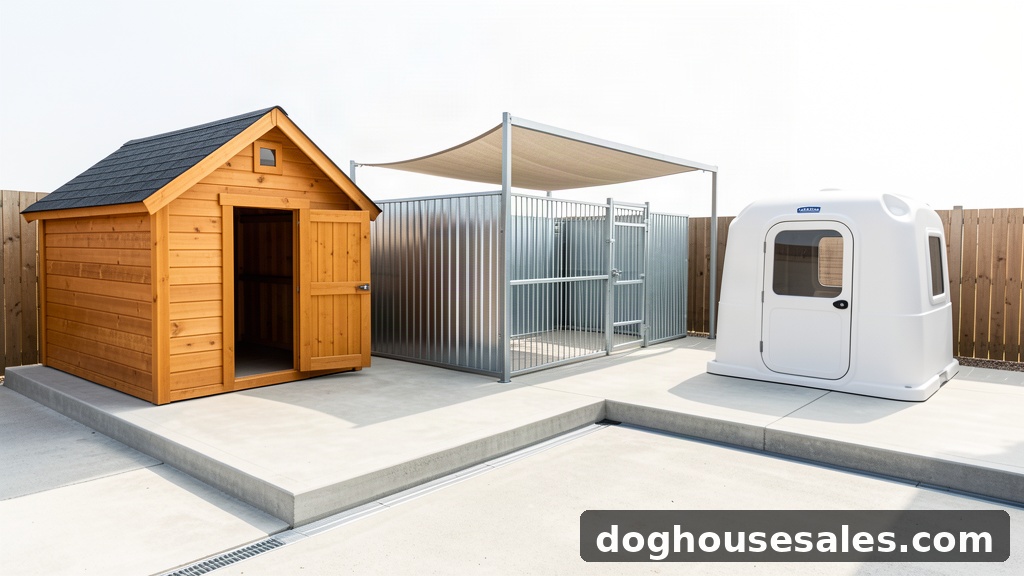
If you are weighing which materials are most suitable for premium dog houses in commercial settings, the short answer is that no single material wins. Wash-down facilities do best with UV-stabilized polymer or fiberglass; showcase spaces do best with cedar cladding over a designed frame; and security runs do best with coated or galvanized steel. What separates a commercial-grade unit from a decorative one is not the material name on the listing but the thickness, the joints, the drainage, and whether the supplier will put a load rating in writing.
This guide sets out the four material families that survive commercial use, the test data that matters versus the test data that does not, and the federal baseline that licensed facilities in the United States already have to meet.
What changes when a dog house has to survive commercial use
A backyard dog house is cleaned a few times a year and occupied by one animal. A commercial unit is cleaned and disinfected between occupants, moved or hosed down by staff, and exposed to urine, disinfectant, UV and weather in the same week. Three loads matter more than appearance:
- Chemical load. Repeated disinfection attacks finishes, sealants and unsealed edges. A finish that lasts three seasons outdoors can fail in one season under daily wash-down.
- Handling load. Units get dragged, stacked and re-positioned. Fasteners that are merely snug on delivery work loose; seams that were never sealed open up.
- Occupancy churn. Every new dog is a new size and a new chewer. Edges, door frames and floor panels take repeated abuse that a single-pet household never generates.
That is why a premium material for a home can be the wrong material for a facility, and vice versa.
The four material families that hold up
1. Rotomolded and UV-stabilized polymer (HDPE or polyethylene)
Nonporous, easy to hose out, and immune to rot and rust, which makes polymer the default for exposed, frequently cleaned runs. The limits are equally clear: polymer grades and molded wall thickness vary widely, and a shell can flex or creep under sustained load. Ask for the specific resin or grade, the UV-weathering basis, the wall thickness, and engineered or tested roof and floor load ratings. A generic claim that HDPE is “strong” does not tell you what a finished house will carry.
2. Fiberglass-reinforced plastic (FRP)
FRP panels and shells give you a stiff, corrosion-resistant surface that tolerates wash-down chemicals better than most painted finishes. Performance depends on resin type, fiber content, laminate construction and UV surface protection, so inspect edges and impact damage and ask for repair guidance before you buy a fleet of them. Require panel and laminate specifications plus a product-specific structural rating.
3. Cedar and solid exterior timber on a designed frame
Cedar is attractive, naturally resistant to decay and insects, and it insulates better than metal or thin polymer. It is still wood: exposure, detailing, finish and maintenance decide how long it lasts. Treat framing and cladding as two separate decisions. Specify species, grade, member sizes, spans, fasteners and finish, and have the frame designed for local snow and wind loads. “Cedar” on its own is a species, not a structural rating.
4. Galvanized or coated steel
Steel is the right answer for security and for heavy-duty enclosure components: it is strong, it resists chewing, and with galvanizing or a multi-layer coating it survives wet environments. It is not insulation. Steel conducts heat and cold, so a steel run needs shade, a raised dry floor and a separate insulated sleeping box if animals are housed overnight in freezing or extreme heat.
Material comparison at a glance
| Material | Where it wins | Cleaning routine | Insulation | Require from the supplier |
|---|---|---|---|---|
| UV-stabilized HDPE / rotomolded polymer | Wash-down runs, wet climates, high-churn boarding | Hose and disinfect; no refinishing | Low unless double-walled or lined | Resin grade, wall thickness, UV basis, rated roof and floor loads |
| Fiberglass-reinforced plastic | Chemical-heavy disinfection, stiff panels | Wipe or hose; inspect edges | Low to moderate | Laminate spec, UV topcoat, damage repair method |
| Cedar / solid exterior timber | Showcase areas, quiet sleeping boxes, cold climates | Re-oil or re-stain on schedule | Highest of the four | Species, grade, spans, fastener spec, snow and wind design |
| Galvanized or coated steel | Security runs, large or escape-prone dogs | Hose; touch up coating at chips | None; needs a separate sleeping box | Coating system, gauge, connection details, corrosion warranty |
What ASTM tests actually prove about a dog house
ASTM D638 (tensile), D790 (flexural), D256 (Izod impact) and D648 (heat-deflection temperature) characterize a material specimen. They do not establish the load capacity of an assembled dog house, which depends on wall thickness, geometry, joints, supports and anchorage.
That distinction is the single most useful filter in this category. Supplier data sheets that quote ASTM numbers are describing a coupon of plastic, not the unit you are buying. When a listing says “impact resistant” or “heavy duty” with no stated test method and no rating, you have no engineering claim at all. Ask for the rating and the basis behind it, and if people or equipment will sit on a roof, or the unit will carry snow, have the anchorage and loads checked against local building requirements.
The federal baseline for licensed facilities
In the United States, facilities licensed under the Animal Welfare Act already have a materials rule to meet. The USDA standards for primary enclosures require, among other things, that enclosures be “designed and constructed of suitable materials so that they are structurally sound” and kept in good repair (9 CFR 3.6). The same section adds requirements that read like a purchasing spec:
- No sharp points or edges that could injure animals.
- Enclosures that contain animals securely and keep other animals out.
- Surfaces that let animals remain dry and clean, with all contact surfaces readily cleaned and sanitized.
- Shelter from extreme temperatures and weather, plus shade for every animal housed at once.
- Floors that protect feet and legs, and mesh or slatted floors that do not let feet pass through.
The federal floor-space formula for a dog is the square of (body length in inches + 6), divided by 144, which gives required floor space in square feet. Interior height must be at least 6 inches above the head of the tallest dog standing normally.
Worked example: a dog measuring 30 inches from nose to tail base needs (30 + 6) squared, divided by 144, or 9.0 square feet of floor. A unit advertised at 46 by 40 inches gives about 12.8 square feet gross, but raised floors, wall thickness and door frames eat into that, so the usable figure is what you should be comparing. These are minimums for licensed housing, not a design brief, and local and state rules can be stricter. Check your own licensing authority before you spec a build.
Interior dimensions decide the fit, not the exterior number
Product listings publish exterior dimensions because they are easy to measure. Use interior ones. Published examples show how much space walls, floors and frames consume:
- Lucky Kennel, medium: 26 x 18.75 x 20 in exterior, 24 x 18 x 17 in interior, 27 lb unit weight, guidance for dogs under 50 lb.
- Lucky Kennel, large: 38 x 24 x 29 in exterior, 35.75 x 22 x 26.5 in interior, 45 lb unit weight, guidance for dogs of 70 to 110 lb.
- A resin outdoor house listed at 46 x 40 x 40 in, claimed for one dog up to 150 lb or two dogs up to 70 lb each.
Weight is a weak sizing proxy. Dogs of the same weight differ substantially in height and body length, and a roomy interior behind a low or narrow doorway is still a bad fit.
The practical check from Petmate’s sizing guidance is to confirm the dog can stand, sit, turn and lie down comfortably, and that the doorway does not touch its head, ears, tail or paws on the way in. In a facility, run that check against the largest dog the run will ever hold, not the average one.
Five checks to put in a commercial purchase spec
- Material and grade in writing. Species and grade for timber, resin and wall thickness for polymer, gauge and coating system for steel. Brand adjectives are not specifications.
- Rated roof and floor loads, with the basis. Require the number and whether it comes from a test or an engineering calculation.
- Cleaning and chemical guidance. Which disinfectants the finish tolerates, and what re-coating interval the maker expects. If the answer is “any cleaner”, get it in writing anyway.
- Serviceability. Removable floors, openable roofs and replaceable pans are what make a unit last a decade in a facility. Fixed, glued or riveted panels turn a small repair into a replacement.
- Fasteners and corrosion class. Stainless or coated fasteners everywhere they touch treated timber, and drainage that moves water away from the floor rather than through it.
Where commercial buyers get it wrong
Owner reviews of insulated houses repeatedly flag the same three problems, and each one is a specification question rather than bad luck. Parts arriving loose and needing re-tightening suggest fasteners that should be checked and re-torqued on delivery. Insulation material escaping in transit points to insulation that is not fully enclosed, which matters far more when a unit is moved between runs. And dogs refusing to enter a fully enclosed design is a sightline problem: an animal that cannot see out may not settle, so test acceptance before committing a whole bank of runs to one model.
The fourth mistake is buying by brand of material instead of by maintenance regime. Wood looks better and insulates better, but needs scheduled refinishing and is vulnerable to chewing. Plastic washes easily and resists weather, but can be less attractive and can degrade under long sun exposure. Metal is strong but adds no insulation. Match the material to exposure, cleaning frequency and chewing risk, then insulate or climate-control separately.
Off-the-shelf options that fit a commercial brief
If you are fitting out a small facility rather than commissioning a build, these are the specs worth comparing, drawn from our own catalogue:
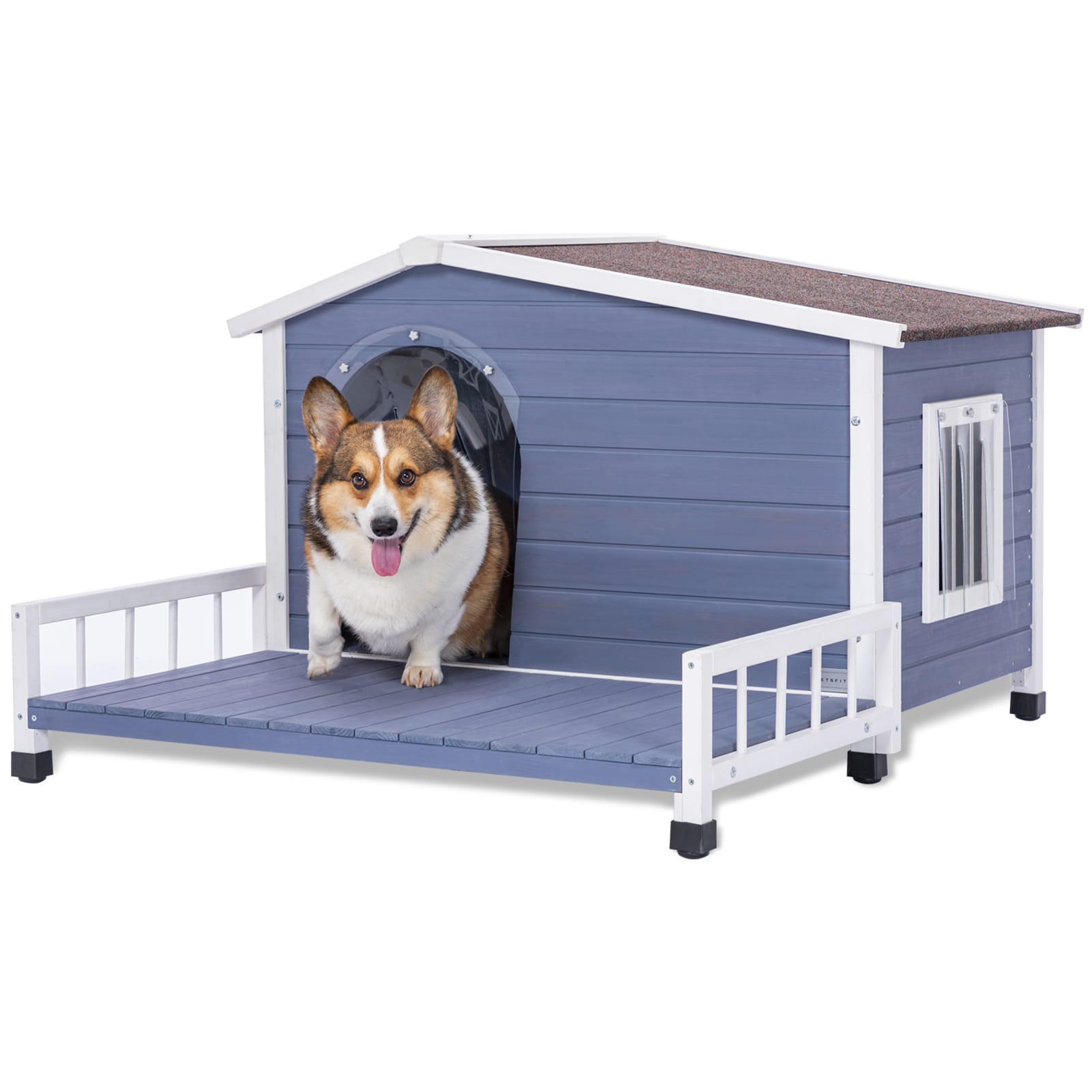
- Deluxe Wooden Dog House – 100% natural cedar with a waterproof asphalt roof, raised feet, a removable floor and an openable roof for cleaning. Listed at 45 x 54 x 33 in and 50.60 lb, sized for small and medium dogs. The openable roof and removable floor are the two features that matter most in staff-serviced use. More on species and construction in our wooden dog house buying guide.
- 48 inch Heavy Duty Dog Kennel With Roof – carbon steel with a multi-layer hammertone finish described as rust, corrosion and fade resistant, two removable ABS pans with a containing lip, and a published capacity weight of 220 lb. The removable pans are what make between-dog cleaning realistic.
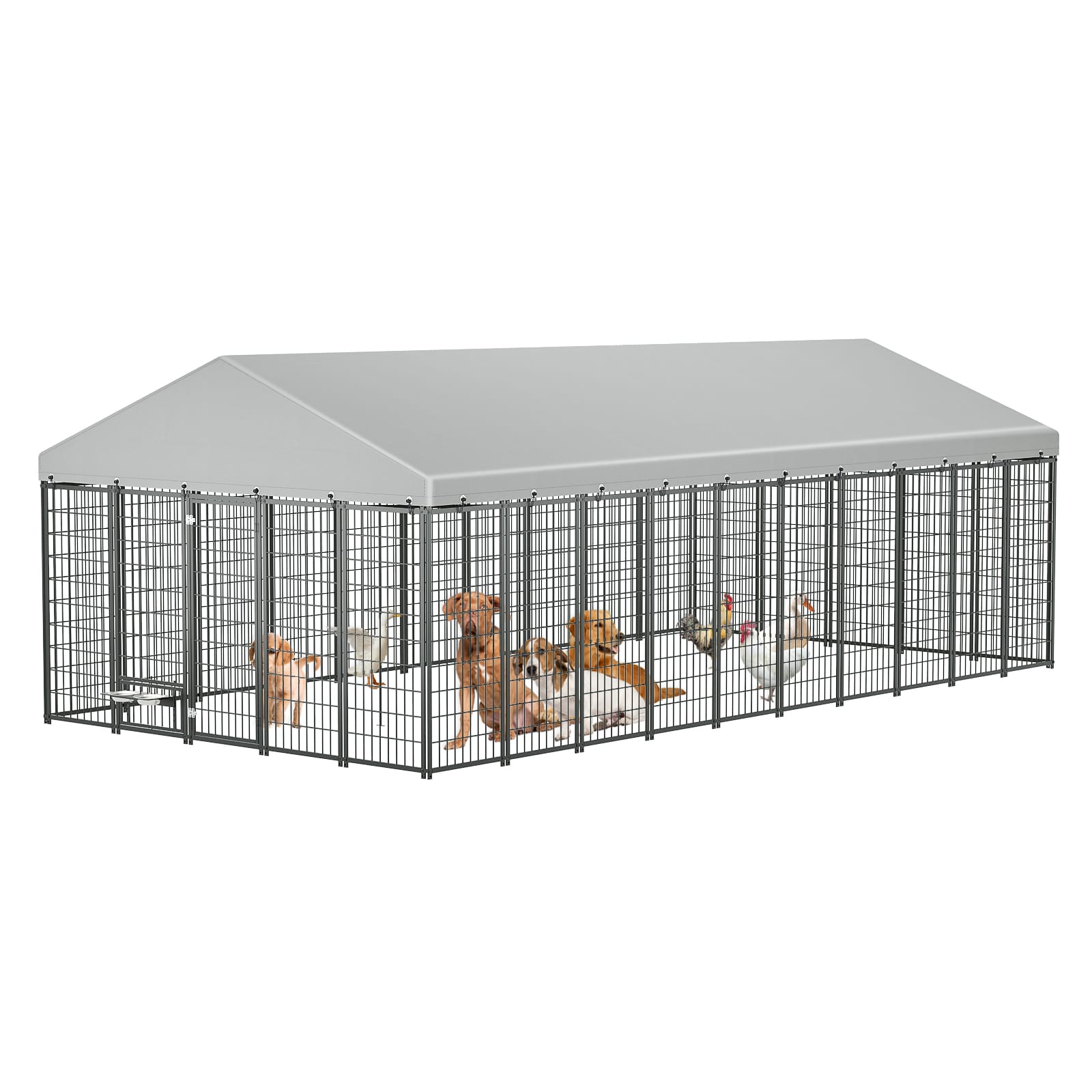
- Metal Animal Hutch with Roof Cover – 18.9 x 9.6 x 6.76 ft of metal frame with added load-bearing columns, a double door lock and a windproof, UV-resistant roof cover. A multi-animal option where you need volume rather than insulation.

If you are choosing by material across the whole catalogue, start from the the solid wood range or the metal range. For placement and weather detailing, see our guide to weather-resistant dog house materials by location, and for enclosure strength read the heavy duty dog kennel buying guide.
Two commercial-style steel options worth benchmarking against a custom build: the vidaXL Outdoor Dog Kennel with Roof, a galvanized steel kennel with polyethylene roof and side panels described as water-proof and UV-proof, and the Steel Outdoor Dog Kennel with Canopy, which covers the whole enclosure with an Oxford cloth canopy. For a timber comparison in the same price band, the Tangkula Wooden Dog House Outdoor Indoor is a large elevated wooden unit with an asphalt roof.
Compare dog house materials by build
These collections sort the catalogue the way a facility buyer needs it: by shell material and by build, so wall thickness, coating and roof spec sit one click apart.
- outdoor dog kennels – 17 units, runs and open shelters
- heavy duty dog kennels – thicker frames and locks
- metal dog houses – coated steel shells
- large dog kennels – 9 units for bigger dogs
- solid wood collection – timber-only range
- metal collection – 19 steel units
Frequently asked questions
Which material is best for a dog house used by a boarding kennel?
For most boarding and daycare operations, UV-stabilized polymer or fiberglass is the practical default because it hoses out, tolerates disinfectant and never needs refinishing. Add steel for security runs and a separate insulated wooden or lined sleeping box for overnight cold. Specify wall thickness, UV basis and load ratings rather than relying on the material name.
Is wood or plastic better for a commercial dog house?
Wood insulates better and looks more premium, but it needs scheduled refinishing and is vulnerable to chewing and moisture at the joints. Plastic is easier to clean and resists rot, rust and weather, but insulates poorly on its own. In a facility, cleaning frequency usually decides: daily wash-down favors polymer, low-churn showcase areas favor cedar.
Do ASTM ratings prove a dog house is heavy duty?
No. ASTM D638, D790, D256 and D648 test a material specimen for tensile, flexural, impact and heat-deflection behavior. They say nothing about the assembled house, whose capacity depends on wall thickness, geometry, joints, supports and anchorage. Ask for a rated roof and floor load plus the test or engineering basis behind it.
How much floor space does a dog need in a commercial enclosure?
The USDA formula is the square of (body length in inches + 6), divided by 144, which gives square feet. A 30 inch dog therefore needs about 9.0 square feet, and interior height must be at least 6 inches above the head of the tallest dog standing. Treat these as minimums and check state and local rules, which can be stricter.
Can a commercial dog house be used outdoors all year?
Yes, if the material suits the climate and the unit is detailed for it: raised floor, drainage, shade, and an insulated or lined sleeping compartment for extreme cold or heat. Steel and thin polymer shells add almost no insulation on their own, so an unheated metal run is a shelter, not a warm bed.
The bottom line
For commercial settings, the defensible specification is a cleanable shell, a structurally rated frame, a dry raised floor and a serviceable roof, with the material chosen to match how often staff will wash it. Polymer for wash-down volume, cedar for showcase and insulation, steel for security. Get the interior dimensions and the load rating in writing before you order, and the material argument largely settles itself.
Browsing by material is the fastest way to compare real specifications: start with our large dog house range or the outdoor dog kennel with floor guide if drainage and dry flooring are your priority.
