
Buy Guide
Can a Dog Cage Be Left Outside in the Weather?
Oct
Can a Dog Cage Be Left Outside in the Weather?
Definition: A dog cage can be left outside in the weather only when it is an outdoor-rated kennel that its manufacturer approves for permanent exposure, sits on drained and anchored ground, and carries a roof that sheds rain and blocks sun. An indoor wire crate is not built for that.
Most people asking whether a dog cage can stay outside are not planning to leave a dog in it through a storm. They want a safe place the dog can use on a patio, a porch or a fenced yard, and they want to know whether the cage they already own will survive a season out there. The honest answer splits into two questions: will the structure survive, and will the dog be safe inside it. Those are different problems with different failure modes, and confusing them is how dogs end up in a rusted crate in the rain.
State-law quick check: does keeping a dog outdoors require “adequate shelter”?(state-by-state citations checked against the official state code · verified 2026-10-15)
If you keep a dog outdoors, several US states require adequate shelter by statute. These are the citations we verified against the official state code; the numbers after each link are not our summary – read the statute itself.
| State | Statute | Source |
|---|---|---|
| Texas | Tex. Health & Safety Code § 821.102 | official text |
| Pennsylvania | 18 Pa. Cons. Stat. § 5532(a)(2) | official text |
| Michigan | Mich. Comp. Laws § 750.50(1)(i)-(iii) | official text |
| Washington | RCW 16.52.310(2)(c)(iii) | official text |
| Vermont | 13 V.S.A. § 365 | official text |
How to check your own state in 3 steps
- Search your state code for “adequate shelter” / “proper shelter” (official legislature site, not a blog).
- City and county ordinances are often stricter than state law: kennel limits, tethering hours, setbacks and noise.
- HOA rules and rental leases can add requirements the statute does not.
Reference only, not legal advice. Statutes are amended – read the official text for your state and municipality before you rely on it, and check local ordinances before buying or installing an outdoor kennel.
Federal baseline: the USDA Animal Welfare Act governs licensing and inspection of commercial breeders, not the shelter standard for pet owners – the shelter duty for owners comes from state law, e.g. Texas Tex. Health & Safety Code § 821.102. City and county ordinances can be stricter than either.
The short answer
An indoor wire crate: no. It is designed for a climate-controlled room. Left out, the tray rusts, the wire coating fails, the latch stiffens, and it offers no shade and no rain protection at all.
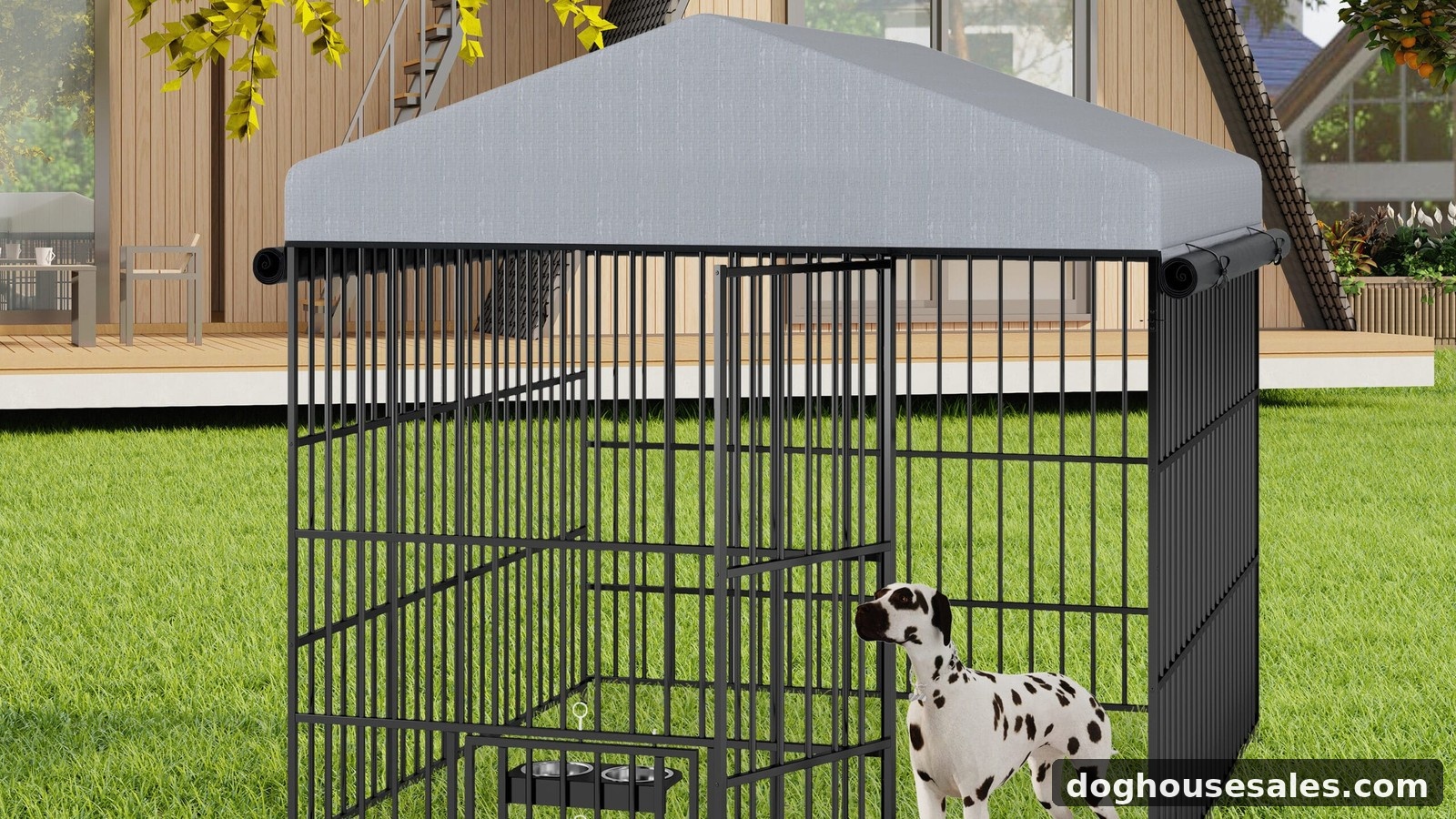
A purpose-built outdoor kennel: yes, with conditions. The maker has to allow outdoor use, the site has to drain, the frame has to be anchored, the roof has to be pitched or at least taut and UV-stable, and you have to inspect it. A covered kennel is also not a substitute for shade, dry bedding and ventilation.
There is no general published standard that assigns a weather, snow-load or wind rating to dog cages as a product category. The ratings that exist are product-specific claims from individual makers, which is why “weather-resistant” on a listing tells you almost nothing until you read what it is applied to.
What “outdoor-rated” has to mean in practice
Four things separate a kennel that lasts outside from one that quietly degrades. Check them before anything else, because no accessory fixes a missing one:
- The maker says so in writing. A listing that documents outdoor installation, anchoring and drainage is the only basis for leaving a cage out permanently. If the manual only describes indoor use, treat the product as indoor-only.
- The frame resists corrosion at its weak points, not just on its faces. Zinc coatings protect steel, but cut edges, welds, scratches and standing water are where corrosion starts and spreads.
- The roof is a roof, not a bag. A tarp cover with no support sags, pools water and tears. A pitched metal roof sheds water; a flat PE canopy is a rain fly unless the maker states otherwise.
- The ground drains and the frame is anchored. A kennel sitting in a puddle is a rust bath. A kennel that is not anchored is a sail once the wind gets under the roof.
Materials: what each one actually promises
Material names are marketing shorthand. This table records what a material implies about outdoor durability, and what it does not prove. The middle column is the useful one, and the right column is the part listings leave out.
| Construction | What it implies outdoors | What it does not prove |
|---|---|---|
| Galvanized steel | A zinc coating shields the steel from corrosion, so it is common in outdoor frames and mesh | Coating thickness, service life, or a load rating. Cut edges, welds and standing water still rust |
| Powder-coated steel | The coating adds corrosion and scratch protection while it stays intact | That “rust-resistant” means rated for continuous exposure, or for how long |
| Aluminum | Does not rust the way ordinary steel does, and is used in fully welded heavy-duty crates | That it is stronger or more secure. Aluminum still corrodes in some conditions |
| Welded wire or PVC-coated mesh | Mesh spacing, weld quality and frame attachment set containment strength | Any published force or impact rating. A coating is not a bite rating |
| PE canopy or tarp roof | Common removable shade and rain cover; often described as UV- and water-resistant | A snow-load or wind rating, unless one is explicitly stated |
| Composite panels | Moisture-resistant crates exist that are listed for indoor/outdoor use | Moisture resistance is not a structural rating or a long-exposure rating |
| Wood frame with metal roof | Common in outdoor dog houses and cedar kennels; a galvanized-steel roof is normal | That any given roof pitch or fastener set handles your local snow load |
Snow, wind and rain: the numbers that are actually published
Load figures in this category are product-specific. Where a maker publishes a snow or wind rating, it describes that named product tested as assembled, so it does not carry over to a different kennel of the same footprint. One cedar kennel with a 29-gauge galvanized-steel roof, for example, is listed by its retailer as tested for up to 2,600 lb (1,179 kg) of snow at 30 in (76 cm) and for 100 mph (160.9 km/h) winds.
What you can generalise is the failure pattern. Read enough buyer reviews and the roof assembly is the part that gives up first: one reviewer of a steel kennel describes the roof collapsing after a night of rain, another describes a cover arriving torn, and a third notes a canopy that did not cover the kennel as pictured. Frames rarely fail on day one. Covers do.
How much cage an outdoor dog actually needs
Two numbers matter and they are not the same: the cage the dog sleeps in, and the run the dog exercises in. For a crate or dog house, the dog must be able to stand at full height, turn around, and lie fully stretched out. One sizing guide puts the rule at 4-6 in (10.2-15.2 cm) added to the dog’s measured length and height to set minimum interior dimensions.
For an outdoor exercise run, published guidance scales floor area with body weight, and panel height with jumping risk:
| Dog weight | Suggested run floor area | Suggested panel height |
|---|---|---|
| Under 25 lb (11.3 kg) | 30-40 sq ft (2.8-3.7 sq m) | 4-5 ft (1.2-1.5 m) |
| 25-50 lb (11.3-22.7 kg) | 50 sq ft (4.6 sq m) | 4-5 ft (1.2-1.5 m), taller for jumpers |
| 50-90 lb (22.7-40.8 kg) | 80-100 sq ft (7.4-9.3 sq m) | 6 ft (1.8 m) or more |
| Over 90 lb (40.8 kg) | 100 sq ft (9.3 sq m) or more | 6 ft (1.8 m) or more |
Measure the interior, not the footprint. The single most common sizing complaint in reviews is that a kennel arrived smaller than the photos suggested, and advertised weight ranges are a rough filter, not a measurement. If you are sizing from scratch, the guide to large outdoor dog kennels with roofs walks through roof types and footprints in the same order you will actually shop.

Heat, cold and the wind chill problem
A roof blocks sun, but it also traps air. In summer a covered kennel becomes an oven unless air moves through it, so shade, cross-ventilation and water come before anything else. In winter the risk inverts: metal conducts heat away from the dog, bedding gets damp, and a covered kennel keeps rain off while holding in cold, humid air.
Wind is the part owners underestimate most. A dry dog in still air at 20 F (-6.7 C) is in a very different situation from the same dog in a 25 mph wind, and the gap widens as temperature falls. The National Weather Service wind chill chart is worth reading once against your local forecast, because it converts “it is only freezing” into an exposure number you can act on. Emergency planning guidance makes the same point from the other direction: pets need a plan for extreme weather, not just a structure.
Practical thresholds, in the order most owners hit them:
- Damp beats cold. A dry dog with dry bedding tolerates cold far better than a wet dog in a draft. Elevate bedding off the floor and keep a spare set to swap.
- Short-coated, small, senior and brachycephalic dogs should not be out unsupervised in extremes. Their surface-area-to-mass ratio and airway shape work against them in both heat and cold.
- Bring the dog in for storms, ice and heat waves. No kennel rating covers a dog’s welfare in a downpour or a 95 F (35 C) afternoon.
- Frozen water is a hard stop. A cage with no liquid water is not a place to leave a dog, whatever the frame is rated for.
Setting a cage up so it survives its first winter
- Pick drained ground with natural shade. Slightly high ground, away from roof runoff and sprinkler overspray. Standing water under a galvanized frame is the fastest route to rust.
- Anchor the frame before the first wind event. Ground anchors or stakes at the corners, and check that raised legs actually bed into soil rather than resting on pavers.
- Fit the roof so water leaves it. A pitched roof sheds; a flat canopy needs tension and a slope. Confirm what the cover covers, since reviews repeatedly describe canopies that stop short of the frame.
- Raise the sleeping surface. A floor deck or an elevated bed keeps the dog off cold, wet ground and out of splash. Floor options are compared in the outdoor dog kennel floor guide.
- Inspect monthly, and after every storm. Rust at welds and cut edges, bent wire, loose fasteners, failed mesh, worn tarp, and any gap a muzzle or paw can work into.
If you are choosing the cage itself, browse the dog crates and kennels collection for outdoor-rated frames, or the metal kennels and houses category if corrosion resistance is the deciding factor. Two starting points that match the setup above: the large outdoor dog kennel for a single-dog yard run, and the 10 x 10 ft heavy-duty outdoor dog kennel when you need run space as well as shelter. Both are built for ground installation, which is the part most indoor crates cannot do.

What typically fails, and what to buy instead
Three product classes keep turning up in buyer complaints, and each has a straightforward fix:
- The “waterproof” cover that is not. Look for a supported, UV-stable roof with a stated pitch, and read reviews that mention rain specifically. For a deeper material comparison by climate, see the guide to weather-resistant dog house materials by location.
- The gap or weak latch. Check mesh spacing, panel joints, door alignment and latch security before leaving a dog unattended. Reviews describe dogs working heads and paws through openings that looked closed in photos.
- The undersized kennel sold on a weight range. Interior dimensions, not the advertised range, decide whether the dog can stand and turn. The heavy duty dog kennel buying guide covers frame and weld quality, and the waterproof dog cage guide covers rust-prone joints in detail.
If you want a benchmark for what a genuinely outdoor-rated frame looks like, three currently listed kennels are useful reference points. The vidaXL Outdoor Dog Kennel with Roof pairs galvanized steel with a UV-protected polyethylene canopy. The Petony Large Outdoor Dog Enclosure is a galvanized steel outdoor enclosure with a covered top. The blightor 7.8 x 7.8 ft Outdoor Dog Kennel uses 1.25 in galvanized steel tubing. None of these listings publishes a snow-load or wind rating, which is exactly the gap described above: ask the seller for the assembled rating if your site sees real snow.
Shop outdoor kennels by run size, frame and roof
These collections are the ones that answer the two questions above: how much run the dog needs, and which frame will still be standing after a wet season.
- outdoor dog kennel
- heavy duty dog kennel
- dog kennel for large dogs
- large dog kennel
- all dog crates and kennels
- metal dog kennels and houses
Frequently asked questions
Can I leave a wire dog crate outside overnight?
No. A wire crate has no roof, no rain protection and a coated frame designed for indoor humidity, and its tray will hold water. Overnight exposure accelerates rust at the welds and leaves the dog with no dry bedding. Use an outdoor-rated kennel with a roof, or bring the crate inside.
Is a covered dog kennel enough shelter in winter?
A cover keeps rain off but does not warm the air, and metal conducts heat away from the dog. Winter shelter needs dry elevated bedding, a wind-blocked side, ventilation that is not a draft across the dog, and unfrozen water. Below about 20 F (-6.7 C), check wind chill and bring short-coated or small dogs in.
Will a galvanized steel kennel rust outside?
It can. The zinc coating slows corrosion, but cut edges, welds, scratched panels and standing water are unprotected points, and poor drainage keeps the frame wet. Set the kennel on drained ground, keep the coating intact, and inspect monthly for the first season. Rust-resistant is not rust-proof.
How much space does a dog need in an outdoor kennel?
For a sleeping crate, add 4-6 in (10.2-15.2 cm) to your dog’s measured length and height. For an exercise run, guidance suggests 30-40 sq ft (2.8-3.7 sq m) under 25 lb (11.3 kg) and 100 sq ft (9.3 sq m) or more above 90 lb (40.8 kg), with 6 ft (1.8 m) panels for large or jumping dogs.
Do I need a permit to keep a dog kennel outside?
Sometimes. State law sets a baseline duty of adequate shelter in many states, and city or county ordinances are frequently stricter about kennel counts, setbacks, tethering hours and noise. HOA rules and rental leases add another layer. Check local ordinances before you install, and treat this article as a starting point, not legal advice.
{“@context”:”https://schema.org”,”@type”:”FAQPage”,”mainEntity”:[{“@type”:”Question”,”name”:”Can I leave a wire dog crate outside overnight?”,”acceptedAnswer”:{“@type”:”Answer”,”text”:”No. A wire crate has no roof, no rain protection and a coated frame designed for indoor humidity, and its tray will hold water. Overnight exposure accelerates rust at the welds and leaves the dog with no dry bedding. Use an outdoor-rated kennel with a roof, or bring the crate inside.”}},{“@type”:”Question”,”name”:”Is a covered dog kennel enough shelter in winter?”,”acceptedAnswer”:{“@type”:”Answer”,”text”:”A cover keeps rain off but does not warm the air, and metal conducts heat away from the dog. Winter shelter needs dry elevated bedding, a wind-blocked side, ventilation that is not a draft across the dog, and unfrozen water. Below about 20 F (-6.7 C), check wind chill and bring short-coated or small dogs in.”}},{“@type”:”Question”,”name”:”Will a galvanized steel kennel rust outside?”,”acceptedAnswer”:{“@type”:”Answer”,”text”:”It can. The zinc coating slows corrosion, but cut edges, welds, scratched panels and standing water are unprotected points, and poor drainage keeps the frame wet. Set the kennel on drained ground, keep the coating intact, and inspect monthly for the first season. Rust-resistant is not rust-proof.”}},{“@type”:”Question”,”name”:”How much space does a dog need in an outdoor kennel?”,”acceptedAnswer”:{“@type”:”Answer”,”text”:”For a sleeping crate, add 4-6 in (10.2-15.2 cm) to your dog’s measured length and height. For an exercise run, guidance suggests 30-40 sq ft (2.8-3.7 sq m) under 25 lb (11.3 kg) and 100 sq ft (9.3 sq m) or more above 90 lb (40.8 kg), with 6 ft (1.8 m) panels for large or jumping dogs.”}},{“@type”:”Question”,”name”:”Do I need a permit to keep a dog kennel outside?”,”acceptedAnswer”:{“@type”:”Answer”,”text”:”Sometimes. State law sets a baseline duty of adequate shelter in many states, and city or county ordinances are frequently stricter about kennel counts, setbacks, tethering hours and noise. HOA rules and rental leases add another layer. Check local ordinances before you install, and treat this article as a starting point, not legal advice.”}}]}Bottom line
A dog cage can be left outside in the weather when it is an outdoor-rated kennel, correctly installed, on ground that drains, with a roof that sheds and a frame you inspect. It should never be left outside simply because it fits through the door. The test is not whether the cage looks sturdy on day one, but whether its coating, roof, anchors and drainage will still be doing their job after a wet season – and whether the dog inside has shade, dry bedding, moving air and water.
Start with the frame and the roof, size from the interior, then add elevation, bedding and a monthly inspection. That sequence solves almost every outdoor failure this category produces.
