
Buy Guide
Large Outdoor Dog Kennel With Roof: Sizing and Roof Types
Oct
Large Outdoor Dog Kennel With Roof: Sizing, Roof Types, and Setup
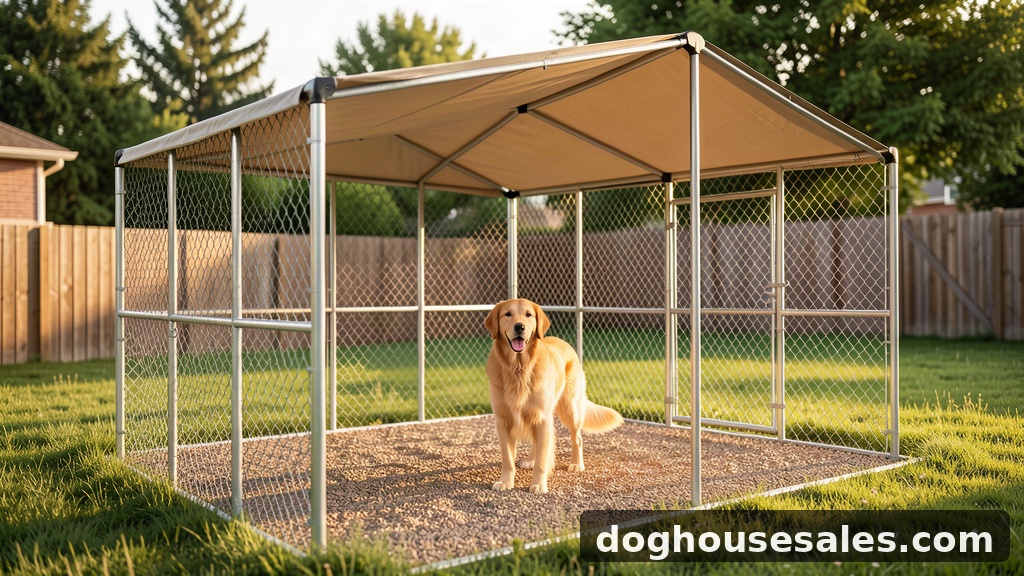
A large outdoor dog kennel with roof is a freestanding steel-framed enclosure for a single large dog or several dogs, topped with a fabric canopy or a rigid metal roof. The roof sheds rain and blocks direct sun; the frame and wire mesh contain the dog.
Most buyers pick a large outdoor dog kennel with roof by the word “large” on the listing, then discover the inside is smaller than the photo suggested, the canopy sags after the first storm, or the door is too low for a standing dog. The three things that actually decide whether the kennel works are usable floor area, what the roof is made of, and how the frame is anchored. This guide walks through each one with figures taken from published listing specs and from the federal enclosure formula.
How much usable floor space does a large dog need?
Start with a measurement, not a label. Measure your dog from the tip of the nose to the base of the tail, then apply the formula used in USDA Animal Welfare Act enclosure rules: add 6 inches to the length, square the result, and divide by 144. That returns the minimum floor area in square feet for one dog.
Measure nose to tail base, add six inches, square it, and divide by 144: a 30-inch dog works out to 9 square feet by the regulated formula, and an outdoor run for the same dog should give 60 square feet or more. The regulated figure is a floor, not a comfort target — it is what a licensed enclosure must provide, not what an active dog with a water bowl, a bed and room to turn needs.
| Dog length, nose to tail base | Minimum floor area | Comparable rectangle |
|---|---|---|
| 24 in | 6.25 sq ft | 2.5 × 2.5 ft |
| 30 in | 9.0 sq ft | 3 × 3 ft |
| 36 in | 12.25 sq ft | 3.5 × 3.5 ft |
| 42 in | 16.0 sq ft | 4 × 4 ft |
| 48 in | 20.25 sq ft | 4.5 × 4.5 ft |
For an outdoor run rather than a crate, the sizing guidance in current buying guides points the same way but much higher: treat 6 × 10 ft (60 sq ft) as the floor for a large dog, and 8 × 12 ft (96 sq ft) or more when the dog uses the kennel for long stretches or is a high-drive breed. A 30-inch dog needs 9 sq ft to meet the regulation and about 60 sq ft to move like a dog.
Check the interior height, not the roof peak
One cited rule is to leave at least 6 inches of clearance above the dog’s head when it stands. This is where roofed kennels go wrong: the listed outside height includes the roof frame and the canopy rise, so a kennel advertised at 7.32 ft does not give a dog 7.32 ft of headroom. Ask for the clear interior height at the wall, then subtract your dog’s standing height plus 6 inches. If the answer is close to zero, the dog will spend its time crouched near the door.
Fabric canopy or rigid steel roof?
“With roof” describes two very different products. One is a fabric canopy stretched over a steel roof frame; the other is a sheet-metal roof on the same kind of frame. Both block sun and shed light rain, but they fail differently.
| Fabric canopy | Rigid metal roof | |
|---|---|---|
| Typical material | Waterproof, UV-resistant polyester, Oxford-type fabric or PE tarp over a steel frame | Galvanized steel or other sheet metal |
| Rain and sun | Good light-rain and shade coverage; extended side skirts reduce rain seepage | Sheds rain without pooling |
| Snow | Not rated. At least one manufacturer states its PE canopy is not snow-load rated and should be removed in heavy snowfall | Material resists tearing, but listings still give no snow-load figure |
| Wind | Catches wind like a sail; needs solid anchoring | Lower profile, still needs anchoring |
| Failure mode | Sagging, pooling, tearing, collapse under load | No fabric to tear, but ratings are unpublished |
No kennel listing reviewed here publishes a numerical snow, wind or roof load rating, so a “waterproof” or “heavy duty” claim is not a structural rating. That gap is the single most useful thing to close before you buy: ask the seller for the roof’s allowable snow load, its wind rating, the tube dimensions and wall thickness, the coating process, and the anchoring requirements. If those numbers do not exist, do not assume a covered kennel is safe under accumulated snow or in a gale.
A pitched or A-frame cover sheds water better than a flat one, which is the difference between a canopy that lasts a season and one that pools and sags after the first heavy rain. If your region gets real snow, plan to take the fabric cover off before winter and treat the kennel as a shaded run rather than a snow-proof structure.
What the frame specs actually tell you
Frame quality is buried in numbers that sellers rarely put in the headline. Look for tube dimensions and wall thickness rather than the words “heavy duty”: one listing reports 19 mm square tubing with 1 mm walls, which is a product-specific example and not a general standard. For the panels, wire diameter, mesh spacing, weld quality and coating matter more than “reinforced mesh” with no values attached. Our own 15×10 ft large outdoor dog kennel with canopy states 1.2-inch diameter galvanized steel tubing and chain-link mesh, which is the kind of figure you can compare against another listing.
- Frame: galvanized or powder-coated steel tubing; ask for tube size and wall thickness.
- Mesh: welded steel wire, galvanized or coated; check gauge and weld quality.
- Coating: some panels are welded before coating, which protects the welds; that claim does not quantify durability on its own.
- Hardware: latches and hinges decide escapes more often than mesh does.
Real footprints: three roofed runs measured the same way
“Large” on a listing can mean 43 sq ft or 202 sq ft. Comparing published dimensions side by side is the only way to see it. These three are from our own catalogue, with outside dimensions and assembly data as listed.
| Model | Outside dimensions | Footprint | Roof | Assembly |
|---|---|---|---|---|
| 15×10 ft large outdoor dog kennel with canopy | 15.06 × 10.09 × 7.32 ft | 152 sq ft | Oxford fabric, silver-coated lining | About 2 hours, 2 packages |
| 20×10 ft large outdoor dog kennel with canopy | 20.06 × 10.09 × 7.32 ft | 202 sq ft | Oxford fabric, silver-coated lining | About 2 hours, 3 packages |
| 10×10 ft heavy-duty outdoor dog kennel | 120 × 120 × 84.65 in | 100 sq ft | Steel frame, 155.5 lb shipped | About 2 hours, 2 packages |
The first two shelter multiple large dogs without crowding a single dog out of the shaded half. The 10×10 is the tighter, heavier build: 100 sq ft of floor and 84.65 inches of outside height, so check the interior clearance against a tall dog before you commit. If you also need a covered crate-sized unit for a porch or a garage, the roofed crate range sits in dog crates and kennels, while the full range of large-footprint enclosures is in large and big dog housing.
Site prep and anchoring
A roof turns the kennel into a sail. Reviews repeatedly flag weak or wobbly anchors, and guides warn that a roofed kennel catches wind that an open pen would let through. Three steps cover most of it:
- Pick a level, well-drained spot. Low ground where water pools turns any floor into mud and rots bedding. A slight crown beats a hollow.
- Match anchors to the surface. Ground stakes for turf, concrete anchors or ballast for hard surfaces. Included stakes are a starting point, not a wind rating.
- Check the door swing and latch reach. You need room to open the gate with a leash in one hand and a bowl in the other.
If you are building on a permanent pad or attaching a site-built roof, local building-code load requirements may apply; the right figures depend on your location and construction, so confirm with your local building authority rather than borrowing a number from a listing. The federal enclosure space formula itself is published in 9 CFR 3.6 if you want to read the source.
Assembly: what owners actually report
The complaints that recur across owner reviews are not about the roof design but about what arrives in the boxes: confusing directions, holes that do not line up, bent or missing parts, damaged packaging, occasionally the wrong door. One reviewer found the fencing weaker than expected for a large dog. The practical response is to unpack and inventory every part before you start building, photograph any damage, and contact the seller before assembly rather than after. Our roofed runs list about 2 hours with two people and ship in two or three packages, so plan for a second pair of hands and a full afternoon the first time.
Comparing online? Three roofed models worth a look
If you are shopping across marketplaces, these three are current listings with roof coverage in the same size class as the runs above:
- LOVMOR 8×4 ft outdoor dog kennel with roof — heavy-duty steel frame with a waterproof canopy and a double-latch door, listed at 96 × 47.2 in.
- 8×6×4 ft welded-steel kennel with roof — UV-resistant waterproof roof, dual locks and ground stakes, listed at 89 lb.
- 6.5×6.5 ft heavy-duty kennel with roof cover — waterproof cover over a steel roof frame, sized for one large dog.
None of the three publishes a snow or wind load rating either, so the same question applies: ask before winter.
large outdoor dog kennel with roof collections worth comparing
These collections are grouped the way buyers actually narrow down this choice, so the specs you need are one click apart.
- outdoor dog kennel
- large dog kennel
- outdoor dog house
- indoor dog kennel
- all dog crates & kennels
- all dog crate furniture
Frequently asked questions
How big should an outdoor kennel be for a large dog?
Use 60 square feet of floor as the floor for a large dog and 96 square feet or more for long stays or active breeds. The regulated minimum is much smaller — (length + 6)² ÷ 144, so a 30-inch dog calculates to 9 square feet — but that is a confinement minimum, not a comfort target.
Can a fabric-roof kennel stay up through snow?
Not safely unless the maker states a snow load. Fabric and PE canopies are commonly sold as waterproof and UV-resistant, which says nothing about accumulated weight. At least one manufacturer says its canopy is not snow-load rated and should be removed in heavy snowfall. Take the cover off before winter in snow country.
Is a roofed kennel enough shelter for a dog in winter?
No. A roof stops rain and sun but has no insulation, no windproof walls and no raised dry floor. In cold or wet weather a kennel needs a proper dog house inside it or beside it, with dry bedding, and the dog still needs a plan for extreme temperatures.
How tall does a kennel need to be for a large dog?
Leave at least 6 inches of clearance above the dog’s head when it stands, measured at the wall rather than at the roof peak. Listed outside height includes the roof frame, so a 7.32 ft kennel may give well under 7 ft of usable headroom at the edge.
Do I need a concrete pad or a permit?
Not always, but the ground must be level and well drained, and anchors must suit the surface. A permanent pad or a site-built roof can bring local building-code load requirements into play, so check with your local building authority before you pour or build.
{“@context”:”https://schema.org”,”@type”:”FAQPage”,”mainEntity”:[{“@type”:”Question”,”name”:”How big should an outdoor kennel be for a large dog?”,”acceptedAnswer”:{“@type”:”Answer”,”text”:”Use 60 square feet of floor as the floor for a large dog and 96 square feet or more for long stays or active breeds. The regulated minimum is much smaller — (length + 6)² ÷ 144, so a 30-inch dog calculates to 9 square feet — but that is a confinement minimum, not a comfort target.”}},{“@type”:”Question”,”name”:”Can a fabric-roof kennel stay up through snow?”,”acceptedAnswer”:{“@type”:”Answer”,”text”:”Not safely unless the maker states a snow load. Fabric and PE canopies are commonly sold as waterproof and UV-resistant, which says nothing about accumulated weight. At least one manufacturer says its canopy is not snow-load rated and should be removed in heavy snowfall. Take the cover off before winter in snow country.”}},{“@type”:”Question”,”name”:”Is a roofed kennel enough shelter for a dog in winter?”,”acceptedAnswer”:{“@type”:”Answer”,”text”:”No. A roof stops rain and sun but has no insulation, no windproof walls and no raised dry floor. In cold or wet weather a kennel needs a proper dog house inside it or beside it, with dry bedding, and the dog still needs a plan for extreme temperatures.”}},{“@type”:”Question”,”name”:”How tall does a kennel need to be for a large dog?”,”acceptedAnswer”:{“@type”:”Answer”,”text”:”Leave at least 6 inches of clearance above the dog’s head when it stands, measured at the wall rather than at the roof peak. Listed outside height includes the roof frame, so a 7.32 ft kennel may give well under 7 ft of usable headroom at the edge.”}},{“@type”:”Question”,”name”:”Do I need a concrete pad or a permit?”,”acceptedAnswer”:{“@type”:”Answer”,”text”:”Not always, but the ground must be level and well drained, and anchors must suit the surface. A permanent pad or a site-built roof can bring local building-code load requirements into play, so check with your local building authority before you pour or build.”}}]}The short version
Buy the footprint, the roof material and the anchor, in that order. Measure your dog nose to tail, size the run at 60 square feet or more for a large dog, confirm the clear interior height above the dog’s standing head, and ask for a roof load rating that the listing probably does not publish. If you want the number that decides the rest, it is usable floor area: everything else — bedding, shade, a second dog, a water bucket that stays upright — has to fit inside it. For floor options and drainage, see our guide to outdoor dog kennels with floors, and for the full size comparison across models, the large dog kennel size chart.
Questions about a specific model’s dimensions or assembly? Our support team answers within one business day, and there is no minimum purchase for free shipping.
