
Buy Guide
Who Makes the Best Residential Dog Kennels? 5 Brands
Nov
Who Makes the Best Residential Dog Kennels? 5 Brands
Definition: A residential dog kennel is an outdoor enclosure built for one household’s dogs rather than for boarding or breeding. The manufacturers most often specified for that job in the US are Priefert, Davis Gates, Stephens Pipe & Steel, Lucky Dog and Otto Environmental.
Ask who makes the best residential dog kennels and you get brand pages, farm-store listings and assembly videos. Almost none of them publish the two numbers that decide whether a run lasts ten years: wire gauge and panel load. This comparison puts the published specifications side by side, names what each manufacturer declines to rate, and gives you the questions to ask before a panel goes into your yard. Where a builder publishes no figure, this page says so instead of guessing.
How This Comparison Was Built
Four criteria, all readable on the manufacturer’s own page or on a retailer listing that reproduces its specification sheet. Nothing below is a test result produced by us, and no panel was load-tested for this article.
- Framing and mesh: tube outside diameter, wall gauge, wire gauge and mesh opening.
- Corrosion approach: galvanizing, powder coat, stainless alloy, or none stated.
- Published strength data: panel load, gate load, design wind speed, or an explicit absence of them.
- Fit for a home: whether the line is sold as a modular kit that one person can erect, or as a custom build.
Manufacturers revise panel specs without notice, so re-check the current sheet before ordering instead of trusting a cached guide.
The Five Manufacturers, Compared
| Manufacturer | Panels and framing (published) | Coating and corrosion approach | Published strength evidence | Best suited to |
|---|---|---|---|---|
| Priefert | 1.66-in OD, 18-gauge galvanized tubing; 8-gauge 2 x 4 in galvanized welded wire; stainless-steel wire at the welds | Architectural-grade powder coat with UV inhibitors over galvanizing | No panel load rating and no allowable wind load published | Buyers who want the fullest published spec sheet in the category |
| Davis Gates | 1 3/8-in galvanized tubing frames; 2 3/8-in chain-link fabric; mid-section brace on 6-ft panels | Galvanized steel | No load capacity, wire gauge or wind rating published | Tall panels that need mid-span bracing |
| Stephens Pipe & Steel | Galvanized chain-link panels in 6-ft and 10-ft formats, with double gates on some SKUs | Galvanized | Material and dimensions only; no gauge or wind rating on the listing | Budget chain-link runs on a fixed footprint |
| Lucky Dog | Modular galvanized chain-link kits; 12-gauge mesh on a welded steel frame; 6-ft panels configure as 10 x 10 ft or 5 x 15 ft | Powder-coated steel frame over galvanized mesh | Kit dimensions published; no load rating | One-box residential kits that ship flat |
| Otto Environmental | Custom cages and doors in 304 stainless steel with HDP privacy panels | Stainless steel | No structural load figures and no standard-based test results published | Wash-down and chemical-cleaning environments |
Read the table by column, not by row. The framing column is where the five genuinely differ: Priefert publishes a tube OD, a tube gauge and a wire gauge, Davis Gates publishes tube and fabric diameters, and the other three publish little more than “galvanized chain link” or an alloy number. That asymmetry is the honest answer to which manufacturer is best: the one whose sheet you can actually verify for your wind zone and your dog.
Priefert: the most fully published panel
Priefert’s premier panels use 18-gauge galvanized tubing filled with 8-gauge 2 x 4 in galvanized welded wire and stainless-steel wire at the welds, then receive an architectural-grade powder coat with UV inhibitors; the tube outside diameter is listed in the table above. Priefert states that combining galvanizing with powder coating gives maximum rust protection from animal urine and cleaning compounds, and notes that damage to either coating can still expose the steel. What the sheet does not give you is a panel load or an allowable wind load, so the coating claim is the strongest thing you can verify.
Davis Gates: bracing over bare numbers
Davis Gates frames its kennel panels from 1 3/8-in galvanized tubing with 2 3/8-in chain-link fabric, and adds a mid-section brace to its 6-ft panels. The brace is the meaningful difference at that height: a 6-ft panel spans more area than a 4-ft one and deflects more under a dog hitting the mesh. The page publishes no load capacity, no wire gauge and no wind rating, so treat the brace as a design signal rather than a measured strength figure.
Lucky Dog and Stephens Pipe & Steel: the panel-kit tier
Lucky Dog sells residential kennels as flat-packed kits: 12-gauge mesh on a welded steel frame, with 6-ft panels that build out as either a 10 x 10 ft or a 5 x 15 ft enclosure. That configurability is the practical advantage for a suburban yard, since you can re-shape the footprint instead of buying new panels. Lucky Dog 2-in-1 Galvanized Chain Link Kennel Enclosure is the 6-ft version of that kit. For a smaller side-yard footprint, Lucky Dog 8 x 4 x 6 ft Outdoor Steel Frame Kennel and Playpen measures 96 x 48 x 72 in with a 1.5-in bar gap.
Otto Environmental: stainless when chemicals dominate
Otto Environmental specifies 304 stainless steel for its custom kennel cages and doors, with HDP privacy panels between runs. Stainless earns its price where a kennel is washed down daily or disinfected with chlorine-based products, because there is no zinc or polymer coating to chip and re-expose. The trade-off is that “stainless” is an alloy claim only: no member sizes, no strength calculation and no test data are published, so the same load questions apply.
Galvanized, Stainless or Aluminum?
Material names are not performance ratings, and that is the single most expensive misunderstanding in this category.
Galvanized steel
Galvanized steel is steel protected by a zinc coating. It is the practical default for an outdoor kennel, but coating quality and coverage decide the service life, especially at cut edges, welds and field repairs, which is where corrosion starts. A powder coat over galvanizing adds a second layer; damage to either layer exposes bare steel.
Stainless steel
Stainless is the corrosion-resistant option for wet, frequently cleaned settings, and Otto Environmental’s 304 alloy is the stainless specification in this group. Strength is a separate question: without member sizes or a design calculation, the alloy tells you about corrosion, not about how the run behaves in a storm.
Aluminum
Aluminum avoids red rust and weighs less than steel, which makes handling and roof frames easier. The listings reviewed here do not identify alloy, temper or structural capacity, so “aluminum” on its own cannot be compared with 18-gauge tubing or 8-gauge wire.
Welded wire versus chain link is a separate axis. Gauge, mesh opening, frame size, weld quality, bracing, connectors and anchoring all change how a panel behaves under impact. The material name alone settles none of it.
What “Heavy Duty” Does Not Tell You
None of the manufacturer pages reviewed for this guide publishes a kennel-specific load standard or a panel load rating. Relevant ASTM fence standards exist and are worth naming in a supplier conversation, but they specify components, not a complete kennel:
- ASTM F2453/F2453M covers welded-wire fence fabric with uniform meshes up to 6 sq in; ASTM F2919/F2919M covers variable patterns or larger meshes. Both appear in ASTM’s fence and steel standards list.
- ASTM F1043 covers strength and protective coatings for industrial steel chain-link fence framework, including wind-related framework design considerations. It is a framework specification, not a kennel-panel rating. See ASTM F1043.
- ASTM A392 is the specification for zinc-coated steel chain-link fence fabric.
A listing that reads “heavy duty”, “commercial grade” or “meets professional durability requirements” is not a substitute for a rated load. For a kennel in a windy exposure, with a large or powerful dog, ask the manufacturer for six things in writing: panel and gate loads, design wind speed or pressure, post and connector details, anchoring instructions, the coating specification, and warranty terms. Then have the layout and anchoring checked against your local conditions.
Sizing a Residential Kennel by Measured Fit
Breed labels and weight charts are the weakest inputs available. Measure the dog standing: nose to the base of the tail for length, floor to the top of the head or ears for height, then add clearance. One published guide recommends 4 in on each dimension, and a heavy-duty crate seller recommends 3-4 in of extra interior length and height for large dogs.
The second error is comparing your dog against the outside of the kennel. Framing, walls and a raised floor all consume usable space, and the gap is larger than most buyers expect. Published figures make the point: Petmate lists 48 x 32 x 35 in outside for its 48-in kennel against 44 x 29 x 32.5 in inside, a full 4 in narrower in one dimension and 2.5 in shorter in height.
| Product (published figures) | Exterior L x W x H | Interior L x W x H | Weight guidance as listed |
|---|---|---|---|
| Petmate 48-in kennel | 48 x 32 x 35 in | 44 x 29 x 32.5 in | 90-125 lb dog |
| Petmate 40-in kennel | 40 x 27 x 30 in | 36.25 x 24.75 x 28.8 in | 70-90 lb dog |
| RuffLand Large | 35 x 22 x 27 in | 33.5 x 21.5 x 25.5 in | No dog-weight limit listed; kennel weighs about 30 lb |
| Lucky Kennel Large | 38 x 24 x 29 in | 35.75 x 22 x 26.5 in | 70-110 lb dog; kennel weighs 45 lb |
Then check the doorway. A run can have a generous interior and still be awkward if the dog has to duck through the gate, or if the latch catches a head, ear or tail on the way in. Finally, re-measure after the bedding and floor are in place, because both reduce the space you just calculated.
Six Mistakes Buyers Make With Residential Kennels
- Buying by breed label. A chart cannot know that your dog is long-backed or tall-eared. Measure the individual animal.
- Using exterior dimensions. Compare interior length, width and height with the dog’s measurements, and account for insulation, framing and a raised floor.
- Measuring a sitting or hunched dog, or including the tail. Both inflate length and hide a ceiling that is too low.
- Ignoring the gate opening. Check the clear opening, not just the panel size.
- Buying for the puppy. Plan for adult size using an adult dog of a similar type; a divider makes an oversized unit workable in the meantime.
- Oversizing without purpose. Excess unused space is harder to keep cozy in cold weather and, in a house-training crate, lets a puppy sleep at one end and soil the other.
Matching the Manufacturer to Your Yard
If your priority is verifiable engineering, start with Priefert and ask its dealer for the panel and wind figures the public page omits. If you need a tall run with mid-span support, Davis Gates braces its 6-ft panels. If you want a kit that arrives in boxes and can be re-shaped later, Lucky Dog’s 2-in-1 configuration does that, and Stephens Pipe & Steel covers the plain galvanized budget tier. If your kennel gets washed down weekly, price Otto’s 304 stainless before you settle on coated steel.
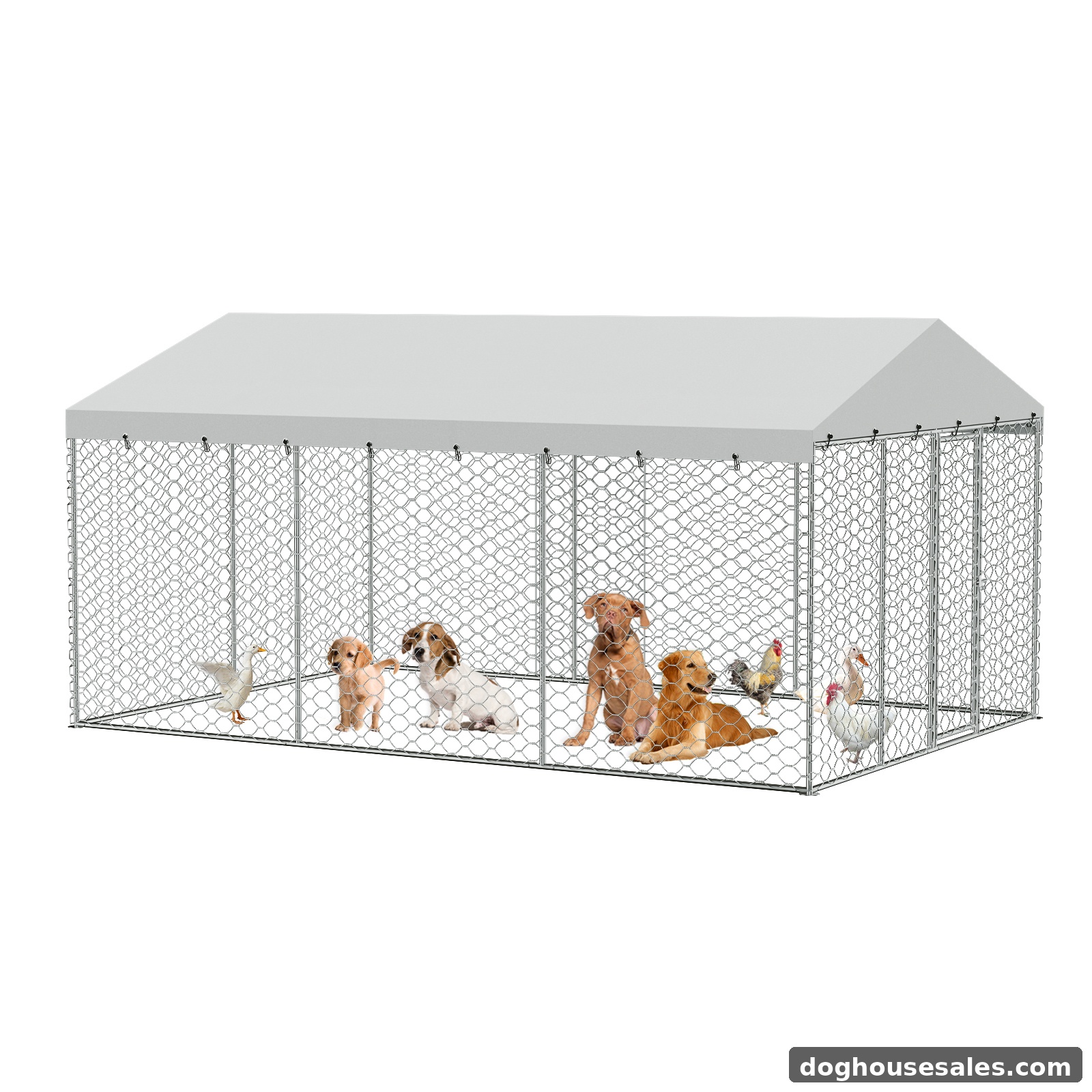
Then finish the job with the parts that no manufacturer will size for you: measure the dog, compare interior dimensions, check the gate, and specify the anchoring. Our dog crates and kennels collection lists the current residential options with interior dimensions on each page, including the 15 x 10 ft large outdoor dog kennel with canopy and the 10 x 10 ft heavy-duty outdoor kennel. For roof and floor choices on a fixed run, read the large outdoor dog kennel with roof guide and the kennel floor guide, then confirm the size against the large dog kennel size chart before you order.

Shop who makes the best residential dog kennels? 5 brands by size and build
These collections are grouped the way buyers actually narrow down this choice, so the specs you need are one click apart.
- outdoor dog kennel
- comfortable dog sofa
- dog couch
- large dog kennel
- all dog crates & kennels
- all dog crate furniture
Frequently Asked Questions
Who are the best manufacturers of residential dog kennels?
There is no independent published ranking. On published specifications, Priefert and Davis Gates disclose the most about framing and mesh, Otto Environmental is the 304 stainless option, and Stephens Pipe & Steel and Lucky Dog cover the galvanized kit tier. None of the five publishes a panel load rating, so the best choice is the builder that will answer your wind and anchoring questions in writing.
Is galvanized or stainless steel better for an outdoor dog kennel?
Galvanized steel is the practical default outdoors because the zinc coating protects the steel at a moderate cost, as long as the coating survives cut edges and welds. Stainless steel, such as the 304 alloy Otto Environmental specifies, resists corrosion better in wet or frequently disinfected runs. Choose stainless when wash-down is routine; choose galvanized when budget and repairability matter more.
What size residential kennel does my dog need?
Measure the dog standing, nose to tail base and floor to the top of the head, then add about 4 in to each dimension, which is the clearance one published guide recommends. Compare that total with the kennel’s interior figures, not its exterior size, and confirm the dog can stand, turn around, lie stretched out and pass through the gate without ducking.
Why do the weight numbers on kennel listings differ so much?
Because the word covers three different measures. A RuffLand Large listing shows about 30 lb, which is the kennel’s own weight; a Petmate 48-in kennel shows 90-125 lb, which is a recommended dog weight; and a strength-test claim such as 4,000 lb of force describes impact resistance. Never compare one figure with another without checking which measure it is.
Are farm-store kennel panels the same as commercial-grade panels?
Not necessarily, and the label will not tell you. Commercial suppliers publish loads, gauges and test data; residential listings often publish only dimensions and a material name. Ask both for panel and gate loads, design wind speed, post and connector details, coating specification and warranty terms, then compare the answers rather than the adjectives.
Specifications in this guide were read on 2026-11-03 from manufacturer and retailer listings. Prices and panel specs change; verify the current sheet before purchase. Corrections and questions: reply through our contact page and we answer within one business day.
