
Buy Guide
Dog House With AC and Heater: What Actually Works
Oct
Dog House With AC and Heater: What Actually Works
A dog house with AC and heater refers to an insulated outdoor shelter paired with active climate control — a portable or window air conditioner plus a small thermostatic heater. It typically combines a six-sided insulated structure with a unit sized in BTU for the house’s interior volume.
If you searched for a dog house with AC and heater, you are probably trying to answer one question: can a shelter keep my dog cool in July and warm in January without moving him inside? Yes — but the structure has to be insulated and sealed before the machine goes in, and the machine has to be sized to the air volume it is conditioning. This guide covers the cooling and heating capacities that fit a real dog house, the temperature thresholds that should override any equipment decision, and which of our outdoor shelters pair cleanly with a portable unit.
State-law quick check: does keeping a dog outdoors require “adequate shelter”?(各州法规速查:户外养犬的「适当遮蔽」要求 · verified 2026-10-15)
If you keep a dog outdoors, several US states require adequate shelter by statute. These are the
citations we verified against the official state code; the numbers after each link are not our summary –
read the statute itself.
| State | Statute | Source |
|---|---|---|
| Texas | Tex. Health & Safety Code § 821.102 | official text |
| Pennsylvania | 18 Pa. Cons. Stat. § 5532(a)(2) | official text |
| Michigan | Mich. Comp. Laws § 750.50(1)(i)-(iii) | official text |
| Washington | RCW 16.52.310(2)(c)(iii) | official text |
| Vermont | 13 V.S.A. § 365 | official text |
How to check your own state in 3 steps
- Search your state code for “adequate shelter” / “proper shelter” (official legislature site, not a blog).
- City and county ordinances are often stricter than state law: kennel limits, tethering hours, setbacks and noise.
- HOA rules and rental leases can add requirements the statute does not.
Reference only, not legal advice. Statutes are amended – read the official text for your state and municipality before you rely on it, and check local ordinances before buying or installing an outdoor kennel.
Federal baseline: the USDA Animal Welfare Act governs licensing and inspection of commercial breeders, not the shelter standard for pet owners – the shelter duty for owners comes from state law, e.g. Texas Tex. Health & Safety Code § 821.102. City and county ordinances can be stricter than either.
Can You Air-Condition a Dog House?
Yes, and the structure decides the machine. A portable unit with an exhaust hose fits a single insulated dog house that sits near an outlet. A window unit needs a kennel building or shed with an opening sized for it. A 12V split system is the only realistic option for a truck dog box, because it runs off the vehicle’s electrical system instead of mains power. Air conditioning a shelter that is not insulated is the one approach that reliably fails: an uninsulated house loses the cold as fast as the compressor makes it, so the unit short-cycles and the interior still swings with the weather.
How Much Cooling Does a Dog House Need?
Buy for interior volume, not for the dog’s weight. Published 2026 buyer’s guidance puts a 4,000–5,000 BTU portable unit against a dog house under 30 cubic feet, and 8,000 BTU or more against a 35+ cubic foot structure holding two large dogs [verify against the unit’s own rating before purchase]. The table below maps that guidance onto the unit types actually sold, with October 2026 street prices so you can compare cost per unit of cooling.
| Interior volume | Portable AC | Window / heat-cool unit | Heating side | Typical price band (Oct 2026) |
|---|---|---|---|---|
| Under 20 cu ft (one small dog) | 3,000–5,000 BTU | Not practical | Thermostatic heat pad | $180–$280 |
| 20–35 cu ft (one medium/large dog) | 5,000–8,000 BTU | 5,000 BTU if the kennel has a window | Heat pad plus an insulated liner | $180–$360 |
| 35+ cu ft (two large dogs, or a kennel room) | 8,000–10,000 BTU | 8,000 BTU heat-and-cool window unit | Reverse-cycle heat | $360–$435 |
Price references measured October 2026: a 5,000 BTU window unit at $177.99, an 8,000 BTU heat-and-cool unit at $359.99, a 10,000 BTU 12V split system at $432.90, and a 3,000 BTU portable unit built for dog houses at $279.99. Dividing BTU by price, the window unit delivered about 28 BTU per dollar against 11 for the small portable — the trade is installation flexibility against efficiency.
Two 2026 units are worth naming because their listings target this exact use case: a 3,000 BTU portable whose product page names dog houses as the intended application (Movejoy 3,000 BTU portable air conditioner) and a 10,000 BTU rotary-compressor portable that is oversized for a single house but suits a large insulated kennel (PETSITE 10,000 BTU portable AC). For a kennel building with a window opening, the Midea 5,000 BTU window unit covers roughly 150 sq ft at the lowest cost per BTU of anything in that comparison.
The Heating Side: What Belongs in a Dog House
Heating a dog house is easier than cooling it, because a dog supplies part of the heat. Two rules keep it safe. First, any powered heater needs a thermostat: heated pads sold for pets commonly advertise an adjustable range around 89–116°F, and a pad without a thermostat can overheat a small enclosure [confirm the model’s rating and UL listing before use]. Second, never seal a shelter completely — a heater in an airtight box builds moisture, and damp bedding is what actually chills a dog.
- Thermostatic heat pad — cheapest option, best inside a house with a raised floor and a door baffle.
- Reverse-cycle portable or window unit — one machine for both seasons; the 8,000 BTU class covers a large house or small kennel room.
- Insulated liner or foam board — not a heater, but it is what makes a 1,500 W heater behave like a 2,000 W one.
- Bedding — cedar or straw bedding adds insulation; avoid loose heated pads with a chewer.
Temperature Limits That Override the Equipment
Equipment choices should sit inside veterinary guidance, not replace it. Two reference points are worth committing to memory.
Most dogs are not troubled by cold until the air drops below about 45°F, small breeds, thin-coated dogs, and very young, old, or sick dogs are at risk below 32°F, and below 20°F every dog can develop hypothermia or frostbite during extended exposure — PetMD’s cold-weather guidance.
The AVMA’s position is blunter: cats and dogs should be kept inside during cold weather, no pet should be left outside for long periods in below-freezing temperatures, and if you cannot bring a dog in, you should provide a warm, solid shelter against the wind. A conditioned dog house reduces the risk; it does not remove it.
In practice that means a climate-controlled house is a comfort and safety upgrade for a dog that spends supervised time outdoors, not a substitute for bringing him in on a 15°F night.
Pick the Structure First, the Machine Second
Insulation coverage decides how well any AC or heater performs. Listings that advertise foam in all six surfaces — four walls, floor, and roof — hold a set temperature far longer than models insulated on two or three sides, and a chew-resistant frame keeps the liner intact.
These are the shelters from our own range that pair well with active climate control:
- 60.2-inch large outdoor dog house — the most interior volume in our outdoor lineup, which is what an 8,000 BTU class unit needs to run efficiently.
- wooden outdoor dog house — solid wood walls accept rigid foam board and a door baffle without special brackets.
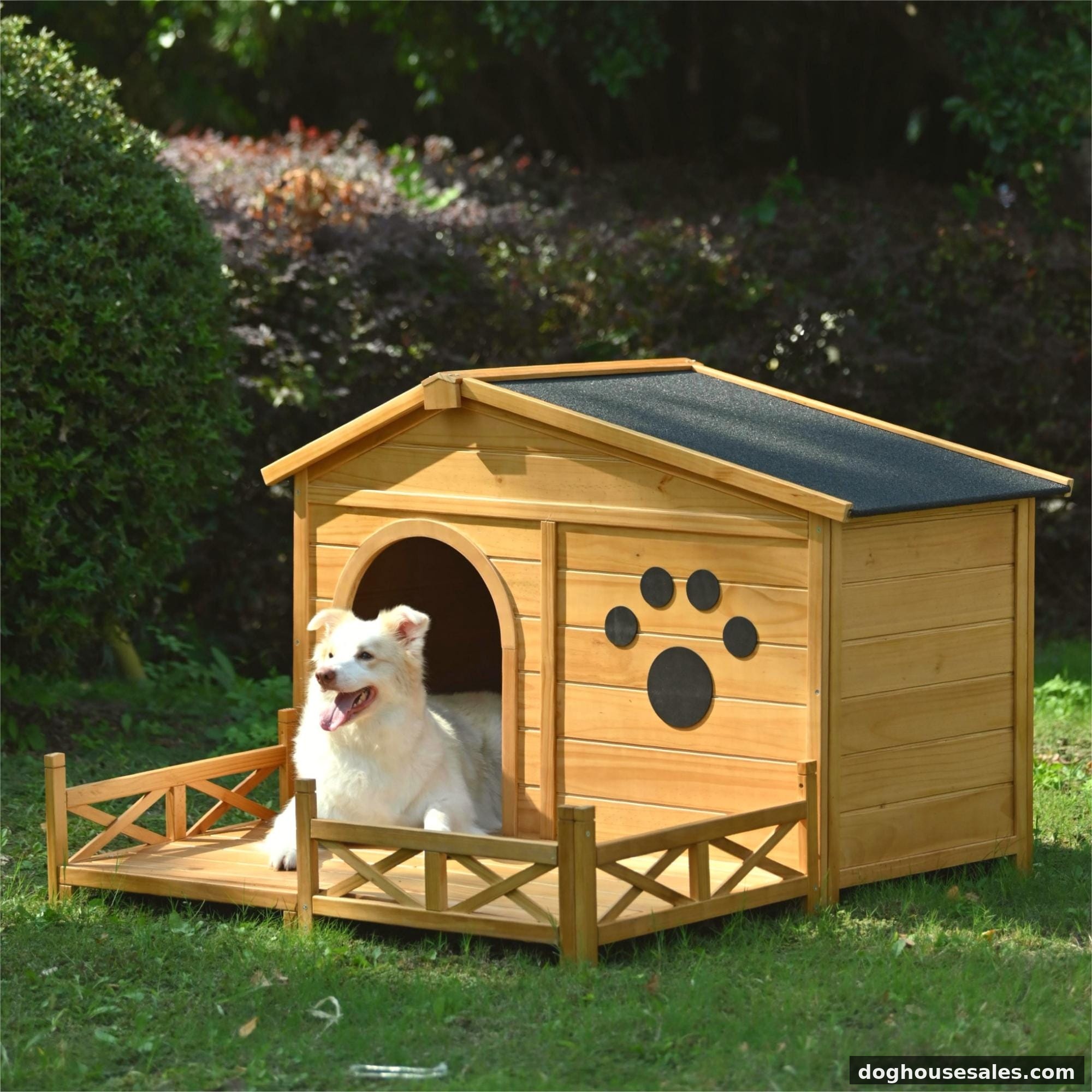
- 48-inch wooden dog house with porch — the porch shades the entry, which is the hottest surface on a summer-facing house.
- medium metal outdoor dog kennel — a kennel run rather than a house; the right shell if you plan a window unit and a shaded roof panel.
If the plan is a portable AC, an insulated wooden house with a raised floor is the better base. If the plan is a heated pad only, a mid-size wooden house holds the pad’s warmth better than a large one, because a dog’s body heat is part of the equation.
Setting It Up: Six Steps
- Measure the interior. Stand, turn, and lie down — the house should allow all three with about 2–4 inches of clearance and no more, because excess air volume is dead space the unit has to condition.
- Seal the shell. Caulk panel joints and check the roof line; an unsealed house leaks conditioned air at the seams.
- Insulate all six surfaces. Walls, floor, and roof. Foam board or a purpose-built liner both work.
- Fit a door baffle or flap. Wind is the biggest heat thief; a flap also stops the AC from escaping.
- Place the unit outside the sleeping area. Route the exhaust away from the entry and keep the cord out of the dog’s reach.
- Add a thermometer you can read from outside. Verify the interior holds the range you set before trusting it.
Cost of Running One
A 5,000 BTU window unit draws roughly 450–500 W, a 10,000 BTU portable roughly 900–1,100 W, and a heated pet pad typically 40–80 W. Running a 500 W unit eight hours a day at a US average of about $0.17 per kWh costs roughly $0.68 a day, or about $20 a month — less than most people expect, and the reason sealing the house matters more than buying a bigger machine. [Utility rates vary by state; treat this as an order-of-magnitude estimate.]
Cost per hour is smaller than most owners assume: a 5,000 BTU window unit draws roughly 450–500 W, so eight hours a day at a US average of about $0.17 per kWh comes to roughly $0.68 a day, or about $20 a month. Sealing the structure moves that number more than buying a larger machine.
Frequently Asked Questions
Can I just put a window air conditioner in a wooden dog house?
A window unit needs a framed opening that can carry its weight, which most single-wall dog houses do not have. A portable unit with an exhaust hose is the practical route for a ready-made house; a window unit belongs in a kennel building or shed with a real wall to cut into.
Will a heated dog house keep my dog warm in freezing weather?
It helps substantially but does not make freezing weather safe. PetMD flags below 20°F as a hypothermia and frostbite risk for every dog during extended exposure, and the AVMA recommends keeping pets inside in cold weather. Use a conditioned house for supervised outdoor time, not as year-round housing.
What size AC does a large dog house need?
Start from interior volume. Under 30 cubic feet takes a 4,000–5,000 BTU portable unit; 35 cubic feet or more holding two large dogs needs 8,000 BTU or higher. Oversizing is a real failure mode: a unit too large for the volume short-cycles and never dehumidifies.
Do I need both an AC and a heater?
Only if you want one shelter to work year-round. A reverse-cycle window or portable unit covers both seasons in one machine, while a heat pad plus a portable AC is usually cheaper to buy and lets you run the cheaper appliance for most of the year.
The Short Version
Insulate and seal the house first, size the unit to interior volume second, and keep veterinary temperature guidance above both. Pair a six-sided insulated shelter — ours start with the 60.2-inch large outdoor dog house and the deluxe wooden dog house — with a 3,000–5,000 BTU portable unit and a thermostatic heat pad, and you have a climate-controlled shelter rather than an expensive box that tracks the weather. Every order ships free, with no minimum purchase.
Questions, corrections, or a sizing check before you buy? Contact our support team through doghousesales.com and we will reply within one business day.
