
Buy Guide
Best Dog Crate for a Small Business: Four Jobs the Crate Has to Do
Nov
Best Dog Crate for a Small Business: Four Jobs the Crate Has to Do
Finding the best dog crate for small business use starts with the dog, not the storefront: the crate has to fit the animal, the floor plan and the cleaning routine at once. A shop crate is opened by more hands and wiped down more often than one at home.
A crate behind a reception desk is asked for things a crate in a spare bedroom never is. It stands in front of customers, it is opened by staff on a rota rather than by one person, and it gets cleaned with whatever the business already buys in bulk. Those three differences change which measurements matter, and they are the reason a crate that reviews well in a living room can be the wrong buy for a 900-square-foot shop.
Four jobs, and only one of them is about the dog
Strip the decision down and a business crate has to do four things: hold the dog comfortably, survive the cleaning cycle, carry a stated load, and satisfy whoever inspects the premises. Most buying guides cover the first and stop. The other three are where a small operator gets caught, because none of them appear in a product photo.
The latch is a staff question, not a dog question
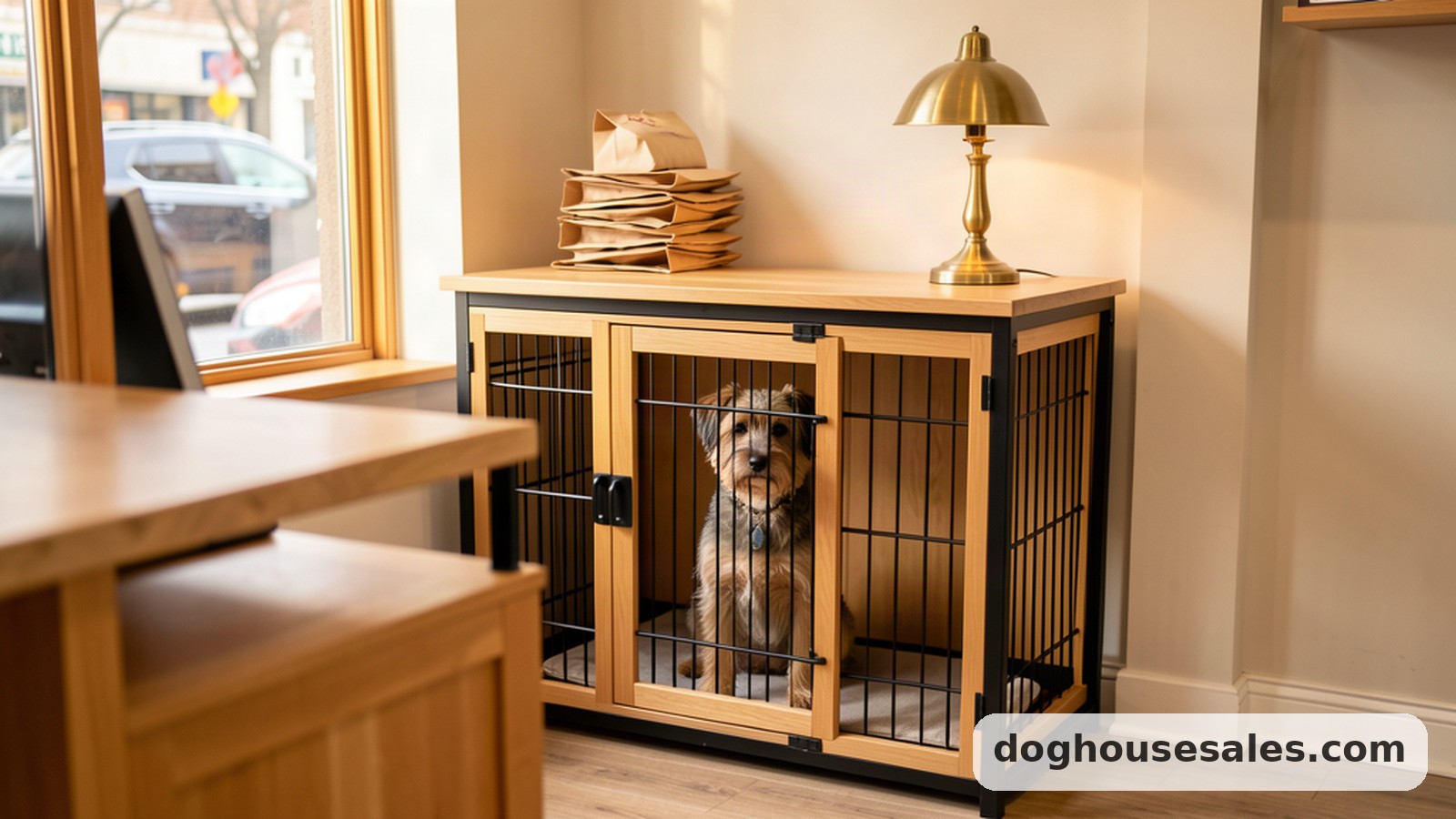
On a shop floor the crate door is opened by employees, by a dog walker at lunch, and sometimes by a customer who thinks the dog looks lonely. Both of our metal models close with two latches per door and add a roof door: the 55-inch heavy duty crate ships with a front door and a roof door, each held by two patent latches, and the 61-inch version uses the same layout with two latches on each. A roof door lets staff lift a dog out without swinging the front door into an aisle. Our 47-inch furniture crate takes the other approach, with three doors, so it can sit in a corner and still open on the side that suits the room.
Cleaning cycle: count the wipes, not the washes
Both metal crates ship with two removable ABS pans, with a lip around the perimeter, and both were designed for indoor and outdoor use. That matters more in a business than at home, because a crate near a door in winter collects grit and a crate in a grooming room collects hair and water. A removable pan goes to the sink; a fixed floor gets scrubbed in place. Particleboard tops, like the ones on our two furniture crates, wipe clean but do not want to be soaked. The Oxford fabric crates fold flat in two sizes, 30 x 20 x 20 inches and 36 x 23 x 23 inches, with three mesh doors; they are the right buy for a dog that travels between sites, and the wrong buy for a room that gets disinfected daily.
Size the dog, then measure the aisle
Two measurements decide fit, and both are taken on the dog. PetMD’s sizing guide starts from nose to the base of the tail and floor to the top of the head, then adds 2 to 4 inches to each. Its chart gives three small-dog reference boxes: 18 x 12 x 14 inches for dogs up to 6 lb, 22 x 14 x 16 inches up to 12 lb, and 24 x 18 x 20 inches for 13 to 25 lb. Those are overall crate sizes, not interior space, and the guide says the dog should still stand without its head touching the top, turn around, and lie flat with legs out.
Interior and exterior are not the same number, and the gap grows on small crates where walls take a bigger share. A Petmate 24-inch carrier is listed at 24 x 16.8 x 14.5 inches and rated for pets up to 15 lb; the same model’s interior is given as 21 x 14.5 x 13.5 inches. That is 3 inches of length, 2.3 inches of width and 1 inch of height spent on walls, door frame and tray lip. The Petmate two-door kennel is the listing those figures come from.
Then measure the floor. Our 47-inch furniture crate is 47.24 inches wide by 29.33 deep by 37.4 high, which is a piece of furniture by any measure; the 80-inch end table is 79.9 inches wide by 27.6 deep. A shop that has 40 inches between the counter and the wall can take the first and not the second, and a hinged front door needs its own swing added on top of the width.
The doorway is its own measurement
WebVet’s crate guide lists the door opening as a separate fit problem from floor area: a crate can have generous interior dimensions and an entrance the dog has to squeeze through. Watch the dog walk in on its own before you commit, and if the listing prints only exterior figures, ask for the opening’s width and height in writing. It is the measurement most often left off a product page, including two of ours.
Five crates, with the figures printed on each product page
Every number below is copied from our own product pages; a blank cell means the page does not publish that figure. Order is width x depth x height.
| Model | Footprint (in) | Material | Access | Rated load |
|---|---|---|---|---|
| 47″ Dog Crate Furniture | 47.24 x 29.33 x 37.4 | Particleboard and steel | Three doors | Top 150 lb, bottom 200 lb |
| 80″ Dog Crate End Table | 79.9 x 27.6 x 32.2 | Particleboard and steel | Two doors, two rooms, 5.36 in base clearance | Top and bottom 150 lb static, 150 lb per room |
| 55″ Heavy Duty Dog Crate | Length in name only | Carbon steel, hammertone finish | Front and roof door, two latches, four lockable casters | Not published |
| 61″ Extra Large Metal Dog Crate | Length in name only | Carbon steel, hammertone finish | Front and roof door, two latches, two ABS pans | Not published |
| Oxford Fabric Dog Crates | 30 x 20 x 20 and 36 x 23 x 23 | Oxford fabric over steel tube | Three mesh doors, folds flat | Not published |
The two metal crates are the weakest entries in that table, and they are also the two that suit a busy shop best. Their pages give the length in the product name and leave width and height to a dimensions tab without a figure in it, so a buyer who needs a 30-inch aisle cannot finish the calculation from the page alone. Ask before ordering, or measure the assembled crate once it arrives and keep the carton until you know it fits.
The material decides how many cleanings it survives
Powder-coated carbon steel is the common choice for a stationary crate that stays put and takes daily handling. The VEVOR 38-inch listing gives Q235 steel, 0.8 mm bars, 37.6 x 23.4 x 29.1 inches, a 43.87 lb shipping weight and a 250 lb maximum load; that figure is the seller’s claim for the model, not a rating for steel crates in general. Coating damage is the thing to watch, because a chip exposes bare steel where disinfectant and urine will find it.
Anodized aluminum suits a crate that moves between rooms or vans. East Coast Crates describes anodized aluminum with stainless hardware and rates its wheel system at 800 lb, which is a figure for the wheels, not for the floor panel or the dog. Stainless steel is the option for a wet room where cleaning chemicals are strong, and the grade has to be named, because “stainless” on its own tells a buyer nothing about thickness or weld quality. Board-and-steel furniture crates carry two separate numbers, one for the top and one for the base: a Yaheetech furniture listing quotes 220 lb and 135 lb, and our own 47-inch crate quotes 150 lb for the top against 200 lb for the bottom.
Ask which part the load rating covers
A rating is only useful if it names the part and the test. Ask whether the number covers the floor, the top, the casters or the assembled unit, whether it is static or dynamic, and what the safety margin was. One warning worth passing on: a search for dog-crate standards turns up ISO 1161 and ASME B30.20, and those two cover cargo-container fittings and below-the-hook lifting devices. Neither is a crate standard, so a listing that leans on them has not told you anything about the crate.
Two dogs, a boarding bench, and what the inspector asks for
A small business often means two dogs: the owner’s dog and the shop dog, or a groomer holding two animals between appointments. The 80-inch end table crate is built for that case, with a double-door two-room layout, a divider wall and a 150 lb static rating for the top and the bottom, plus 150 lb per room. Where dogs are moved rather than lifted, the 55-inch crate’s four lockable casters do the work; the 61-inch crate ships at 78.70 lb, which is a two-person lift unless the roof comes off first.
If the business boards, grooms or trains dogs rather than keeping one, the crate stops being furniture and becomes equipment under local rules. Toronto Animal Services publishes commercial kennel minimum standards that require enclosures to be structurally sound and stable and set out enclosure, floor and space requirements; those are Toronto’s rules for a permitted kennel, not a certification that travels with a product. Animal-care, building, fire and sanitation rules vary by city and county, and a crate sold as “commercial” does not establish compliance with any of them.
What goes in the folder beside the crate
Four documents answer most of the questions a landlord, insurer or inspector will raise: the permit or registration your city requires for the number of dogs on site, the lease clause that covers animals on the premises, the insurance rider naming the business, and the manufacturer’s load and cleaning-compatibility statement in writing. That last one is the document sellers rarely publish and the one a commercial cleaning routine needs most, since the finish, the tray and the hardware all have to tolerate the disinfectant you already use.
The check that takes five minutes
Work through this before you order, with a tape measure and the dog in the room.
- Measure the dog standing: nose to base of the tail, floor to the top of the head, and the widest point across the chest.
- Add 2 to 4 inches to the length and the height, then compare that against the crate’s interior, never its carton size.
- Ask for the door opening’s width and height, and check the chest measurement against the width first.
- Mark the footprint on the floor with tape, add the door swing, and walk the aisle a customer would walk.
- Ask which part the load rating covers, whether it is static, and whether the finish tolerates your cleaning product.
Two of those five answers are usually missing from a product page, which is why the last step is a question to the seller rather than a number to read. Our own catalogue is a fair example: the furniture crates publish footprint and load, and the metal crates publish neither width nor height. If your space is tight, start from the dog crates and kennels collection, then narrow with the crate furniture category or the dog crate furniture tag, and read each page’s dimensions tab before you trust the product name.
For a crate that has to pass as furniture in a customer-facing room, the furniture-style crate review compares the finishes and door layouts, the complete furniture crate guide covers how the pieces are built, and the bedside table crate piece shows the same footprint logic applied to a 24-inch-wide gap. For a small dog behind a reception desk, the MidWest 24-inch iCrate lists 24.77 x 17.92 x 19.5 inches for 12 to 20 lb dogs, with a divider panel and a leak-proof tray. For a stronger frame that stays in one place, the VEVOR 38-inch heavy duty crate is the model whose Q235 steel and 250 lb load claim are quoted above.
Frequently Asked Questions
Can I use a home dog crate in a shop or office?
Usually yes, and the deciding factors are fit, cleaning and paperwork rather than the label on the box. A crate rated for indoor household use will hold a shop dog, but check that the finish tolerates the disinfectant your business uses and that the crate’s stated load rating names the part it covers. If the premises has dogs boarded or held for customers, the local animal-care rules for that use apply before any product choice.
What size crate does a shop dog need?
Size to the dog, not to the room. Measure nose to the base of the tail and floor to the top of the head, add 2 to 4 inches to each, and compare that with the crate’s interior dimensions. PetMD’s chart starts at 18 x 12 x 14 inches for dogs up to 6 lb and reaches 24 x 18 x 20 inches for 13 to 25 lb, but a long, low dog or a tall, compact one can need a different box than its weight suggests.
Is a furniture-style crate strong enough for a business?
It depends on the two numbers the seller publishes. Board-and-steel crates quote the top and the base separately: a Yaheetech listing gives 220 lb and 135 lb, our 47-inch crate gives 150 lb for the top and 200 lb for the bottom, and the 80-inch end table gives 150 lb static for the top and for each room. A lamp, a register and a stack of stock are well inside those figures; a person leaning or sitting on the top is not.
Do I need a permit to keep a crated dog at my business?
It varies by jurisdiction, and the trigger is usually the number of dogs or the commercial activity rather than the crate. Toronto Animal Services, for example, publishes commercial kennel minimum standards for permitted operations. Check your city or county animal-care office, then your lease and your insurer, because a permitted use in the zoning sense can still be excluded by a lease clause or a policy.
How do I stop customers opening the crate door?
Choose a crate whose doors close with two latches, or that opens from the roof, so a single hand cannot work the door while a dog is inside. Both of our metal crates use two latches per door with a front and a roof door; the 47-inch furniture crate spreads three doors around the body so the one facing the aisle can stay shut. Placing the crate behind a counter line helps more than any latch.
