
Buy Guide
Bedside Table Dog Crate: Sizing One That Works Next to a Bed
Nov
Bedside Table Dog Crate: Sizing One That Works Next to a Bed
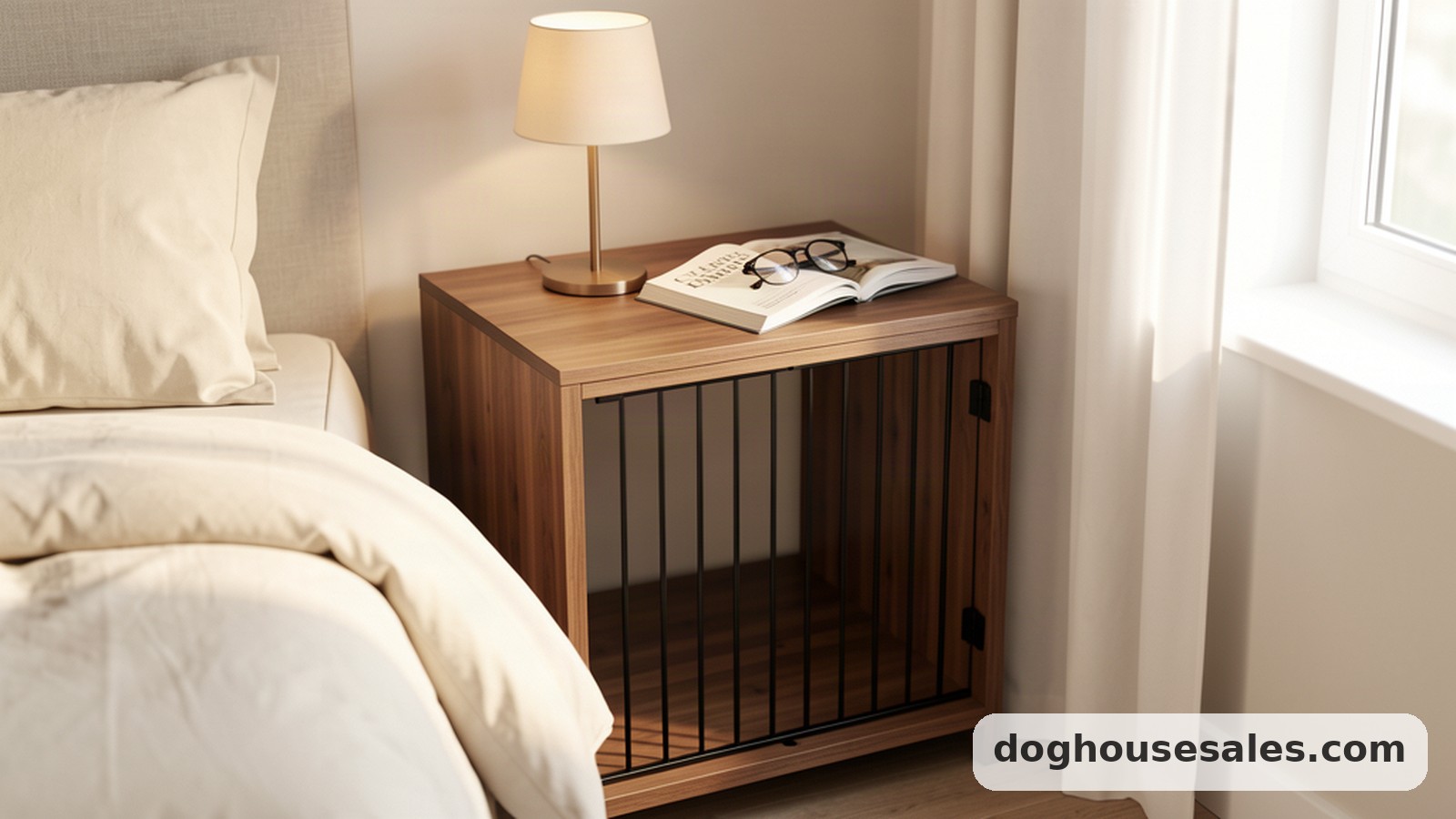
Definition: A bedside table dog crate is a wooden furniture-style crate with a flat top, built to stand where a nightstand would, so the dog sleeps within arm’s reach and the surface above holds a lamp, a phone and a book.
The appeal is obvious: the dog is contained, the bedroom stays uncluttered, and you stop tripping over a wire crate at 3 a.m. The problem is that almost everything sold under this description is an end table crate — sized and proportioned for the side of a sofa, not the side of a bed. Bedside placement adds three constraints the listings never mention: the top has to land near mattress height, the footprint has to fit the gap between bed and wall, and the door has to open into a room rather than into the mattress. This guide works through all three with published dimensions.
Two pieces of furniture hide under one search term
Furniture crates come in height bands, and the band decides where the piece can live. The compact Feandrea side table is listed at 25.2 inches tall. The 38.6-inch model is 26.8 inches tall, the 43.3-inch model is 32.3 inches tall, and our own 47-inch crate furniture is 37.4 inches tall. Those are not cosmetic differences. A low bed with a 24-inch mattress top pairs with the first two; the taller units put the dog in a box that towers over the pillow.
Nothing in the listings calls a unit “nightstand height,” so you have to derive it. Measure the floor-to-mattress-top height on your own bed, then compare it with the crate’s published height. The top should sit close enough to the mattress that you can reach a glass of water without sitting up. If the crate top is six inches above the mattress, every reach becomes a stretch and the dog is sleeping in a cabinet.
Depth matters as much as height, and it is where these pieces give you a bonus. A nightstand is usually shallow; a crate that is 28 or 29 inches deep sticks out into the walking path along the bed. The Feandrea 32.5-inch model is 21.9 inches deep, which is the closest to true nightstand proportions in this group. Our 43-inch walnut fluted crate is 28.7 inches deep and the 47-inch model is 29.33 inches deep — fine against a wall or at the foot of a bed, tight as a bedside companion.
Measure the dog, then add four inches
Every weight rating on these crates is the manufacturer’s dog guidance, not a structural test. The published interior dimensions are the honest starting point, and the gap between exterior and interior is consistent: on the 32.5-inch Feandrea the interior is 29.9 x 18.5 x 21.3 inches against a 32.5 x 21.9 x 25.2 inch exterior, and on the 43.3-inch model it is 40.5 x 27 x 30 inches against 43.3 x 29.9 x 32.3. Roughly two to three inches of every dimension is frame, panel and top.
The sizing rule that survives across buying guides is to measure your dog standing — nose to tail base, floor to the top of the head — and leave about four to five inches of extra room beyond that on length and height. Vetstreet recommends that margin; a separate listing in this category advises about four inches.
The margin is not theoretical. One reviewer of a furniture crate reported that an advertised 32-inch bed would not fit a crate with a 31-inch interior, and a review of the small Casual Home end table described an 18-pound Papillon that could not comfortably fit a bed inside the crate. Both owners bought by the label. Measure the dog and subtract the frame.
Both of those reviews fail the same way: the owner compared a bed or a dog against the exterior figure. Vetstreet’s crate guidance is to compare the dog’s measurements with the interior, and so is the advice on the listings in this category.
Width is what usually kills the plan
A crate beside a bed competes for the strip of floor between the mattress and the wall, and that strip is short. Compact: 32.5 inches wide. Mid: 38.6. Large: 43.3. Our walnut fluted crate: 43.3. Our 47-inch crate furniture: 47.24. A tall narrow unit does not exist in this category because the dog needs length to lie down, and length runs along the front.
Before ordering, put a tape measure on the floor: wall to bed frame, and the full depth of the space where the unit will sit. Then add the door swing. Owners report that doors do not open as far as expected, and a front-hinged door that swings 90 degrees needs clear floor in front of it. Slide the crate in tight against the wall and a front door may only open 45 degrees, which is enough to squeeze a dog through and not enough to lift it out.
Sizes, interiors and top loads side by side
All figures below are the listings’ published numbers. Order is width x depth x height, because width is the front elevation of the piece as you stand beside the bed.
| Model | Exterior (in) | Interior (in) | Dog rating | Top load |
|---|---|---|---|---|
| Feandrea 32.5″ side end table | 32.5 x 21.9 x 25.2 | 29.9 x 18.5 x 21.3 | Up to 45 lb | 154 lb static |
| Feandrea 38.6″ side end table | 38.6 x 25.6 x 26.8 | 35.8 x 21.7 x 23.2 | Up to 70 lb | 154 lb static |
| Feandrea 43.3″ side end table | 43.3 x 29.9 x 32.3 | 40.5 x 27 x 30 | Up to 80 lb | 220 lb static |
| 43″ Walnut Fluted Wood Dog Crate | 43.3 x 28.7 x 30.3 | Not published | Not stated | 150 lb top, 150 lb bottom |
| 47″ Dog Crate Furniture | 47.24 x 29.33 x 37.4 | Not published | Not stated | 150 lb top, 200 lb bottom |
The two rows at the bottom are our own, and their missing interior figures are deliberate: the supplier sheet lists product size and load ratings but not the box inside, so we do not print a number we cannot source. If you need the interior on those models before buying, ask us and we will measure a unit rather than guess.
What a 154-pound top load actually promises
Those top-load numbers read like permission to sit on the crate. They are not. The published figures are maximum static loads: Feandrea lists 154 lb on the two smaller units and 220 lb on the 43.3-inch model, and PawHut lists 132 lb for the top against a 110 lb interior capacity. Static load means weight at rest, evenly distributed, on a level floor. It is not a rating for a person dropping onto the edge, a child climbing, or a dog launching off the top.
The clearest evidence that these ratings are not interchangeable comes from a Costway listing that publishes three separate figures on one product: 66 lb for the tabletop, 110 lb for the crate and 33 lb for the side cabinet. One piece of furniture, three capacities, because each panel carries a different load. Treat the top as a lamp shelf. A nightlight, a paperback and a phone are inside the rating; a 40-pound kid using it as a step is not, and neither is a 30-pound dog that learns to jump up there to reach the window.
A word on the wood, since bedside placement puts the panels at eye level. The structural parts are steel bars or tubing; the panels and top are particleboard or MDF on the models documented above. Feandrea’s FSC note on the top applies to wood sourcing, not to strength, and none of the listings we reviewed names a load-test method or a crate safety standard. If a warranty claim ever matters, the manual’s assembly instructions and the retailer’s own capacity figure are what you will be arguing from.
Door side, and the small details that decide the room
Front door only
Most budget units have one door on the long front face. Beside a bed that is workable when the front faces the open floor and the crate is oriented with its short end toward the mattress. It is a mistake when the only wall space puts the front against the bed, because the dog has to be lifted in and out. Look at the listing photos and identify which face carries the latch before you buy, not after the box arrives.
Double doors and side panels
Double-door models — the Feandrea 43.3-inch unit is sold with two doors — solve the bedside problem because you can feed and reach in from the room side while a second panel faces the bed. Costway’s corner model and the PawHut units with divider panels take the same idea further. If your bed sits in a corner and the gap is one-sided, a second access point is worth more than a nicer finish.
Cords, chargers and the lamp cable
Several nightstand-style crates now ship with a charging station built into the top or the side panel, which is the feature that actually differentiates a bedroom crate from a living-room crate. Two cautions: the outlet is on the furniture, so the unit needs to be near a wall socket anyway, and a cord running behind a crate against the wall is a cord a bored dog can reach through the bars. Route the cable above the crate’s reach or behind a solid panel.
What owners report after the crate is assembled
The pattern in reviews of this category is not about finish or price. It is about containment and assembly. Owners describe bars that bent, wood that was chewed through, latches that gave way when a dog pushed against the door, and screws that were hard to seat during assembly. A furniture crate is a piece of furniture with a cage inside it; it is not a heavy-duty containment tool. If your dog has already escaped a wire crate, or chews when left alone, a decorative wooden box is the wrong purchase at any size.
Assembly is the second recurring complaint, and it matters more for a bedroom unit than for a living-room one. These ship flat with an instruction sheet and a quoted build time of around 40 minutes on our models. Build it in the room where it will live, not in the hallway, because a 43-inch assembled crate does not fit through a bedroom door frame at an angle.
If the interior does not fit your dog
When the measurement says no, the honest options are to size up or to use two pieces of furniture instead of one. Sizing up within the furniture category means a wider front, which usually means giving up the bedside position. Our 80-inch dog crate end table is 32.3 inches tall and 27.6 inches deep, the lowest of our crate furniture and therefore the closest to a bedroom-appropriate height, while the 47-inch dog crate furniture stands 37.6 inches tall and trades height for more interior length. Both sit in the dog crate furniture range, and the sizing logic for the end-table members of that family is set out in our Casual Home pet crate end table guide and the wider dog kennel end table comparison.
If you want the furniture look without the furniture footprint, two smaller units do the bedside job for a dog under roughly 45 lb. The DWANTON 32.5-inch dog crate furniture is sold as a nightstand or TV stand with a waterproof cushion and double doors, and the Zakkart 30-inch barn door crate is the narrowest option we found that still advertises a nightstand use, at 30 inches wide and rated for dogs up to 40 lb.
The alternative worth considering seriously is separation: a plain wire crate in the corner of the room and a real nightstand beside the bed. It costs less, gives the dog more air, and removes the daily question of whether the top can take the weight. Our end table crate buying guide covers when the dual-purpose piece earns its price and when it does not.
Frequently Asked Questions
What size dog fits a bedside table dog crate?
Size by interior length and height, not weight rating. The compact Feandrea unit gives 29.9 x 18.5 x 21.3 inches of interior for dogs up to 45 lb, the 38.6-inch model gives 35.8 x 21.7 x 23.2 inches for up to 70 lb, and the 43.3-inch model gives 40.5 x 27 x 30 inches for up to 80 lb. Measure the dog standing and add four to five inches before comparing.
Can a dog crate really work as a nightstand?
Yes, if the top lands near your mattress height and the door opens toward open floor. The functional limit is the top load, which is a static rating — 154 lb on the smaller Feandrea units, 220 lb on the largest — not a seat rating. A lamp, a phone and a book are fine; sitting or standing on it is not.
How wide is a bedside table dog crate?
In the models documented here, 32.5 inches at the compact end and 47.24 inches on our 47-inch crate furniture. Nothing in the category is as narrow as a conventional nightstand, so measure the gap between the bed frame and the wall before ordering, then add the door’s swing.
Will a wooden crate hold a dog that chews or tries to escape?
Usually not. Reviews of furniture crates describe chewed panels, bent bars and latches that failed when a dog pushed the door, and the panels are particleboard or MDF rather than solid timber. A dog with an escape history needs a conventional heavy-duty crate, not a decorative one.
Does the crate need to be at mattress height?
It needs to be close enough that you can reach the top without sitting up, and low enough that the interior height still suits your dog. Those two goals pull in opposite directions on tall beds, which is why the 25-to-27 inch units sell better for bedroom use than the 32-inch-and-up models.
