
Buy Guide
Dog House Dimensions for a German Shepherd: Size Chart
Nov
Dog House Dimensions for a German Shepherd: Size Chart
Definition: Dog house dimensions for a German Shepherd are the interior numbers that decide whether the dog can stand, turn and lie flat: floor length and width taken from its nose-to-flank measurement, ceiling peak taken from its standing height, and door height taken from its shoulder height.
Dog house dimensions for a German Shepherd are where most buyers get it wrong, because “large” houses are large on the outside and tight where it counts. A male German Shepherd stands 24 to 26 inches at the shoulder and a female 22 to 24 inches, according to the AKC breed standard, and that height has to fit under a roof peak and through a door. When the peak is too low the dog cannot stand up straight; when the doorway is too low it simply refuses to go in.
The fix is three measurements taken at home, checked against two numbers on the listing: interior dimensions and the door opening. Below is the sizing math for the breed’s height range, what four large-breed houses actually publish, and the fit checks that catch a house which is big enough on paper and wrong in the yard.
Measure the dog first, in three numbers
Breed tables are starting points, because two German Shepherds of the same weight can differ by two inches of leg. Take these three numbers with the dog standing on level ground and looking straight ahead.
1. Standing height: toes to the top of the head
Measure from the floor to the highest point of the head, not to the withers. Ears count, because a dog that has to fold them back to stand is in a house that is too short. Blythe Wood Works sets the minimum interior peak at 125 percent of that figure, measured to the top of the head. Blythe Wood Works publishes an A-B-C sizing guide any builder can apply: door opening 3 inches above the shoulder-to-chest drop, floor length and width at least the dog’s nose-to-flank measure, and a peak at 125 percent of standing height.
2. Nose-to-flank length
Measure from the tip of the nose to the back of the hindquarters, with the tail left out of the tape. That number becomes the minimum interior floor length, and it also becomes the minimum width if you want the dog to turn around without scraping both walls. A German Shepherd specific guide suggests a rough starting range of 42 to 48 inches long and 30 to 36 inches wide, but treat it as a sanity check on your own tape, not a substitute for it.
3. Doorway clearance
Two published rules circulate and they land close together. Blythe Wood Works sets the opening at least 3 inches taller than the shoulder-to-chest measurement. DG Floors’ dog house size guide sets door height at about 75 to 80 percent of shoulder height, so a 26-inch male needs 19.5 to 20.8 inches and a 22-inch female 16.5 to 17.6 inches. Write the upper number down before you shop.
The sizing math for the AKC height range
Every figure in this table is arithmetic on the two published inputs above, so you can recompute it for your own dog in a minute.
| German Shepherd | Shoulder height | Minimum interior peak height | Doorway range at 75-80% |
|---|---|---|---|
| Female, lower end | 22 in | 27.5 in | 16.5 to 17.6 in |
| Male, upper end | 26 in | 32.5 in | 19.5 to 20.8 in |
| Tall male outside the standard | 28 in | 35 in | 21 to 22.4 in |
The last row matters more than it looks. Working lines and mixed dogs regularly exceed the show standard, and a house that clears a 26-inch dog can be an inch short for a 28-inch one. If your dog measures past 26 inches at the shoulder, size from the tape and ignore every breed chart, including this one.
What four large-breed houses actually publish
Spec sheets are inconsistent about which dimensions they give, and that inconsistency is the single most common reason a buyer ends up with the wrong house. Here is how the published numbers read for four models often sold as German Shepherd shelters.
| Model | Build | Exterior (in) | Interior (in) | Door opening (in) | Maker’s pet limit |
|---|---|---|---|---|---|
| TRIXIE Natura Classic, Large (39518) | Pine, closed-cell foam liner | 45.7 x 31.1 x 32.3 | 41 x 25.5 x 30 | 13.4 x 19.7 | 95 lb |
| TRIXIE Natura Cottage | Pine | 37.8 x 44.1 x 41.3 | Not published | 15 x 21.7 | Not published |
| New Age Pet ECOFLEX Jumbo | Recycled polymer and wood fiber | Not published | 41.5 x 29.6 x 32.3 | Not published | 130 lb |
| Petmate Indigo, Large | Molded plastic igloo | Not published | Not published | About 16 high | Not published |
Read the first row against the math table and the trade-off appears immediately. The interior peak is 30 inches, which clears a 22-inch female (27.5) but sits under the 32.5 inches a 26-inch male needs, and its 19.7-inch door lands at the very top of that male’s 19.5 to 20.8 range. A large female or a young male fits; a tall adult male is at the edge.
Note also that the 95 lb figure is a pet-weight recommendation, not a structural rating. None of these listings publishes a floor load, a roof snow load, a wind resistance figure or an impact test, so a weight limit should never be read as “the roof will hold” or “the frame will survive a storm.” Ask the maker for load data if the house is going somewhere with real weather.
Where the doorway becomes the limit
The entrance is the number buyers skip and the one dogs vote on. One review of the Petmate Indigo Large reports that its roughly 16-inch doorway makes a 75-pound Shepherd crouch to get in, a house whose sleeping area looks generous but whose door is a daily negotiation.
Test the door before you commit. A cheap proxy is a cardboard cutout or a laundry basket opening of the same height: if the dog will not walk through a 19-inch gap in the yard, it will not walk through one in a dog house. The doorway is also the hardest dimension to change afterward, unlike bedding or a flap.
Outside dimensions are not inside space
The gap between the two is where most returns come from. On the TRIXIE Classic above, 45.7 inches of exterior length becomes 41 inches of interior floor, and 31.1 inches of exterior width becomes 25.5 inches inside. Walls, a raised floor and a roof overhang account for the rest.
Breed charts make this harder by disagreeing with each other. One widely copied chart gives German Shepherd ranges of 34 to 36 inches long, 51 to 54 inches wide and 35 to 45 inches high, a shape that is wider than it is long and unlike any house on the market. Treat published breed charts as a hint about scale, and make the manufacturer’s interior figures the deciding number.
Interior length is the one to guard most carefully, because a Shepherd lying stretched out needs the full nose-to-flank length plus clearance at both ends. If a listing gives only exterior dimensions, subtract 3 to 5 inches of length and 5 to 6 inches of width as a working estimate, then confirm with the maker before buying.
Material, insulation and how much space you should give up
Solid pine is the common build for large wooden houses, and tongue-and-groove panels seal tighter than butt joints. Composite such as ECOFLEX holds its shape and resists chewing better than thin pine, at a higher price. Molded plastic is light and easy to hose out, but its usable interior is smaller than the shell suggests.
Insulation changes the sizing decision more than any other feature. A closed-cell foam liner eats roughly an inch of interior on each lined wall, so an insulated house of the same exterior size is measurably tighter inside. The TRIXIE insulated model above publishes a 30-inch interior peak against a 32.3-inch exterior height, and that lost space is the point of the foam.
There is also a real argument against going much bigger than the numbers require. An SPCA outdoor dog house factsheet makes the point plainly: the dimensions of the house are what let a dog hold its own body heat, and an oversized box defeats that. Guides and owner reports agree, and one owner account describes buying a house their Shepherd inspected and then declined to use. Size to the tape plus a few inches of clearance, not to the biggest box that fits the yard.
If the dog lives outdoors year-round, the build matters as much as the dimensions. Solid wood with an asphalt roof and a raised floor is the durable baseline, and the guide to solid wood dog houses covers which species and joints hold up. For winter specifics, insulating a plastic house is a different job from insulating a pine one.
Fit checks before you pay
- Measure standing height, nose-to-flank length and chest-to-shoulder drop. Write all three down.
- Add 25 percent to standing height and require that interior peak figure, not the exterior height.
- Match interior floor length to nose-to-flank length, and check the width allows a turn.
- Compare the door opening against 75 to 80 percent of shoulder height, and take the upper end.
- Confirm the listing publishes interior dimensions. If it does not, ask the seller before ordering.
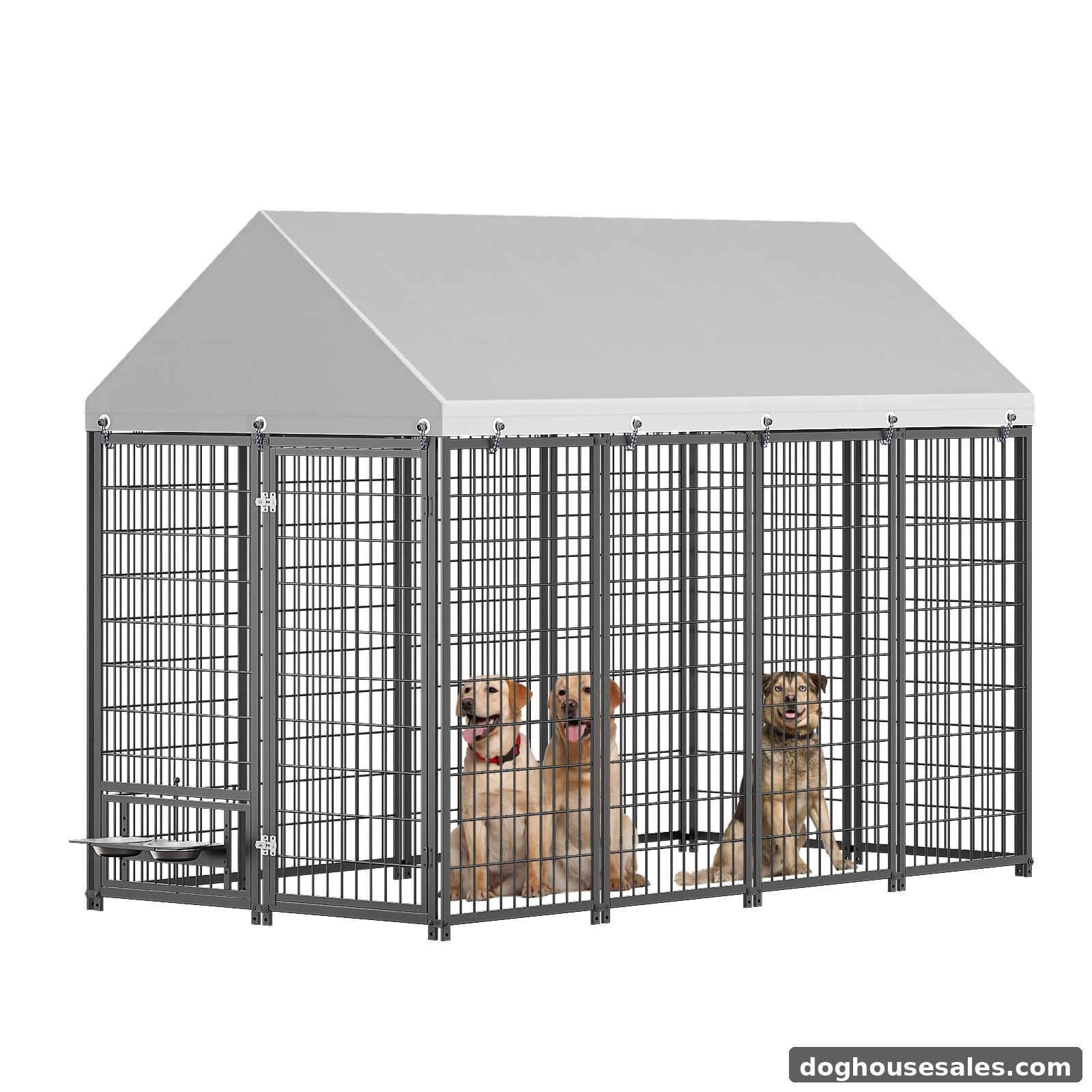
One product example that clears these checks for a large dog is the large dog kennel with a covered run, which measures 7.94 ft long by 4.13 ft wide by 5.95 ft high and gives a Shepherd room to stand, turn and stretch rather than just curl. A 52-inch heavy duty kennel with roof suits a dog that spends short stretches outdoors, and the large and big dog house collection lists the models sized for this weight class. If you would rather compare shapes than numbers, the large dog kennel size chart sets the same three measurements against kennel styles.
Three houses with published interior numbers
For buyers who want a wooden house rather than a run, three models in this class publish enough for a decision. The TRIXIE Natura Classic Insulated dog house lists a 41 by 26 inch interior floor with a 30-inch peak and a 19.5-inch door, which fits a female Shepherd comfortably and a male at the limit. The TRIXIE Natura XXL Classic dog house trades footprint for a 25-inch door and a 41.25-inch interior peak, the safer pick for a tall male. The Petsfit extra large wooden dog house measures 45.6 by 31 by 32.1 inches overall and is rated to 80 lb, which is under most adult males.
Where to compare large-breed dog houses by the numbers
Each collection below groups houses the way this sizing method does: by size class, by build, and by how much room the dog actually gets inside.
- large and big dog house collection
- outdoor dog house models
- large dog house options
- dog kennels for large dogs
- heavy duty dog kennels
Frequently asked questions
What size dog house does a German Shepherd need?
Start from the dog’s own measurements: interior floor at least its nose-to-flank length, interior peak height at least 1.25 times its standing height, and a door about 75 to 80 percent of shoulder height. For a 26-inch male that means roughly 32.5 inches of interior peak and a door of 19.5 to 20.8 inches.
Is a 45-inch dog house big enough for a German Shepherd?
Often, but the exterior length is the wrong number to judge. A 45.7-inch exterior house can publish only 41 inches of interior floor, which suits most females and younger males. Check the interior peak and the door opening as well, since a short door rules out a tall dog regardless of floor length.
How tall should the door opening be for a German Shepherd?
Aim for 75 to 80 percent of shoulder height, or shoulder-to-chest drop plus 1 to 3 inches. On a 26-inch male that is 19.5 to 20.8 inches, and on a 22-inch female 16.5 to 17.6 inches. A 16-inch door is enough to make a 75-pound Shepherd crouch every time it enters.
Should I insulate the house or buy a smaller one?
Insulate first if the dog sleeps outdoors in winter, because a lined house loses about an inch of interior per lined wall and that trade is worth it in cold. Keep the peak and door figures intact, and buy the next size up if the insulated model falls under your dog’s minimums.
Do I need to measure the dog again as it grows?
Yes if the dog is under about two years old. German Shepherds keep filling out in height and chest into their second year, so a house bought at twelve months can be tight at twenty. Measure every six months and expect the door, not the floor, to become the constraint first.
The short version
Three numbers decide whether a German Shepherd fits a house: standing height times 1.25 for the interior peak, nose-to-flank length for the floor, and 75 to 80 percent of shoulder height for the door. Exterior dimensions, breed labels and pet-weight limits all describe something other than usable space, and the doorway is the dimension dogs actually refuse.
Measure your dog this week, write the three minimums on your phone, and compare them against interior specs only. When you are ready to shortlist, the dog crates and kennels collection and the dog house size guide both use the same method, so the numbers will line up instead of contradicting each other.
