
Buy Guide
Dog Crate vs Bean Bag Chair: Which Does Your Dog Need?
Nov
Dog Crate vs Bean Bag Chair: Which Does Your Dog Need?
A dog crate vs bean bag chair comparison comes down to purpose: a crate is a sized, enclosed space for containment, travel and overnight sleep, while a bean bag chair is an open, soft lounging surface that supports a resting dog but holds it nowhere. Owners usually end up comparing the two because both look like “a place for the dog” in a living room, yet only one of them can do the job of the other.
If you are weighing a dog crate vs bean bag chair for your own home, you are probably trying to answer a smaller question: should the dog have a closed den it cannot wander out of, or an open cushion it can sprawl across? Those are different jobs, and buying one to do the other’s work is where most of the disappointment comes from. Below is the sizing math for each, what the safety standards actually cover, and the one combination that works in almost every household.
The short answer
Buy a crate if your dog needs containment: housebreaking, chewing control, safe travel, recovery from surgery, or a predictable overnight spot. Buy a bean bag or foam lounger if your dog already has a safe, contained sleeping place and you want a comfortable open surface for supervised lounging next to the sofa. If you have neither, start with the crate. A crate can be padded into a bed; a bean bag cannot be turned into a crate.
- Containment: crate only. A bean bag has no walls, no door and no latch.
- Joint comfort and sprawling: bean bag or foam sofa, because the fill conforms to the dog’s body instead of holding a fixed rectangle.
- Chewing risk: crate wins for a determined chewer, since most bean bag covers are fabric over loose fill.
- Cleaning: a crate with a tray wipes out in a minute; a bean bag needs a removable, washable cover to stay in the room.
- Floor space: a crate footprint is fixed and known; a bean bag squashes outward and takes more floor than its label suggests.
- Travel: crate only. Nothing else gives a dog a familiar, contained space in a car or at the vet.
What each one actually is
The crate is a structure with a measured interior
A crate is a rigid or semi-rigid enclosure sized to a specific dog. Wire crates use metal panels with a plastic or metal tray, travel crates are often molded plastic, and soft-sided crates are fabric over a frame. The important number is not the exterior length on the box, it is the interior space left after bedding, because that is where the dog actually stands and turns.
The sizing test is simple, and PetMD states it directly: the dog must be able to stand without ducking, turn around, and lie down with its limbs extended. PetMD’s chart recommends at least 2 in (5.1 cm) of head clearance above a standing dog, and pairs crate sizes with weight ranges that are a starting point, not a verdict. A long-backed dog or a tall, narrow breed can need a crate two sizes up from the weight row that seems to match.
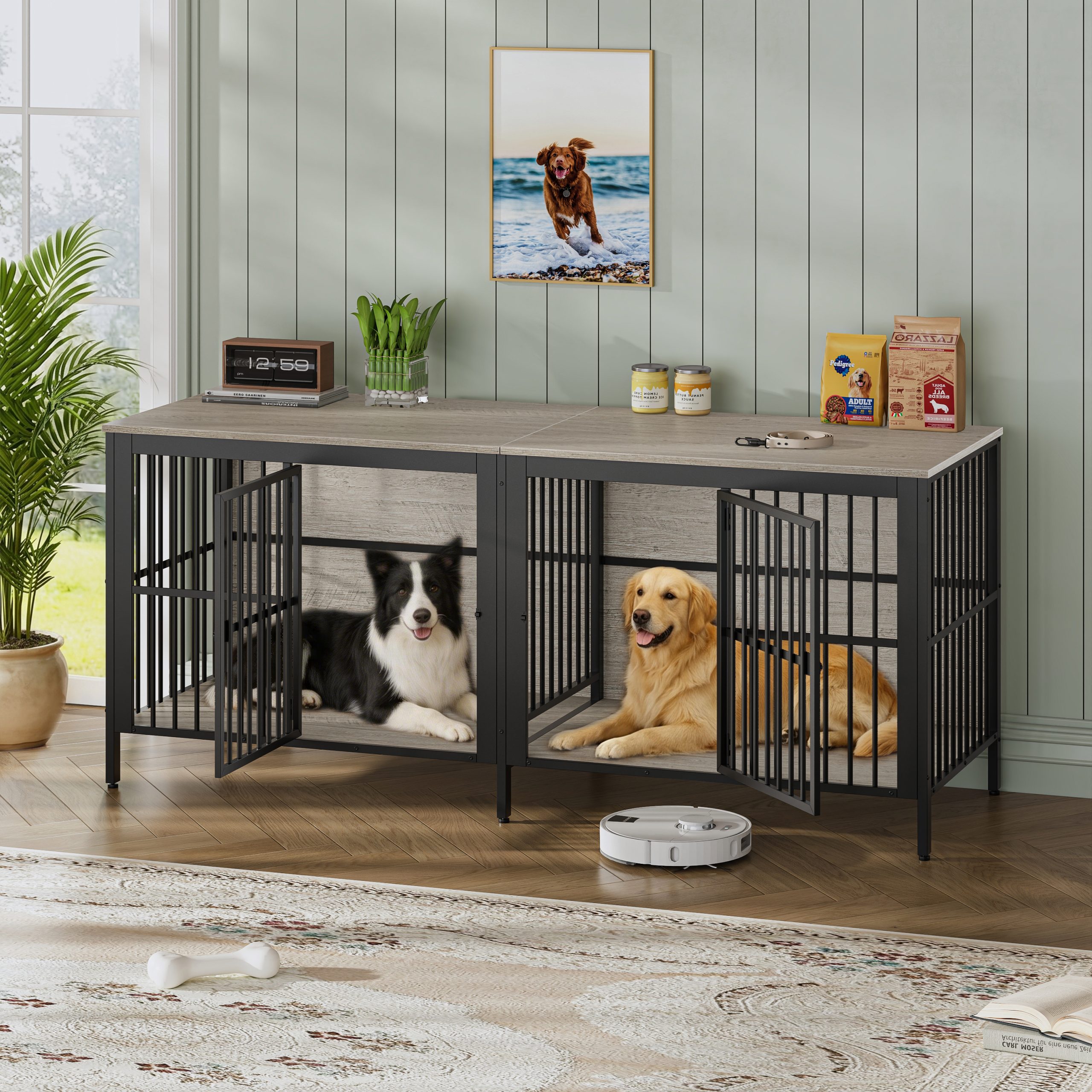
If the crate will live in a living room rather than a utility room, furniture-style models hide the bars behind wood panels. Our dog crate furniture collection lists the panel-built options, including an 80 in dog crate end table sized for large breeds.
The bean bag chair is a soft surface with no boundary
A bean bag chair is a fabric, vinyl or leather cover filled with polymeric or natural beads, or with shredded foam. The fill shifts to conform to whoever sits on it, which is exactly why it feels good and exactly why it is a poor containment structure: the surface changes shape as the dog moves, the “walls” collapse under a paw, and there is no door to close.
Note the material distinction, because it decides which safety specification applies. ASTM F1912-21 covers bead-filled chairs and their covers; shredded-foam or fiber-fill products sit outside its scope. If a listing says “memory foam filled”, you are buying a foam lounger, not a bean bag in the standard’s sense.
Sizing: the crate has a formula, the bean bag has a capacity claim
Crate sizing is arithmetic. Measure the dog’s nose-to-tail base length and standing height, add clearance, then check the crate’s interior dimensions. One widely used retail rule adds 2-4 in (5.1-10.2 cm) to both the length and the height measurement before matching a crate. The chart below comes from PetMD’s published size table and shows how those interior dimensions map onto dog weight.
| Crate interior (L x W x H) | Suggested dog weight | Typical use |
|---|---|---|
| 18 x 12 x 14 in (45.7 x 30.5 x 35.6 cm) | Up to 6 lb (2.7 kg) | Toy breeds, travel |
| 22 x 14 x 16 in (55.9 x 35.6 x 40.6 cm) | Up to 12 lb (5.4 kg) | Small breeds |
| 24 x 18 x 20 in (61.0 x 45.7 x 50.8 cm) | 13-25 lb (5.9-11.3 kg) | Small to medium |
| 30 x 20 x 23 in (76.2 x 50.8 x 58.4 cm) | 26-40 lb (11.8-18.1 kg) | Medium |
| 36 x 24 x 26 in (91.4 x 61.0 x 66.0 cm) | 41-70 lb (18.6-31.8 kg) | Medium to large |
| 42 x 28 x 30 in (106.7 x 71.1 x 76.2 cm) | 71-90 lb (32.2-40.8 kg) | Large |
| 48 x 30 x 32 in (121.9 x 76.2 x 81.3 cm) | 90-110 lb (40.8-49.9 kg) | Extra large |
Quotable: “PetMD’s crate chart pairs a 36 x 24 x 26 in (91.4 x 61.0 x 66.0 cm) crate with dogs of 41-70 lb (18.6-31.8 kg) and recommends at least 2 in (5.1 cm) of head clearance above a standing dog.” Use the chart to shortlist, then measure the dog and the crate interior before you buy.
Bean bag sizing works differently: there is no interior to measure, only an overall footprint and a manufacturer’s maximum user weight. Published capacities on adult chairs in the sources reviewed range from 200 lb (90.7 kg) on a kid-size chair to 400 lb (181.4 kg) on a chair with back support. Those numbers describe a person sitting down. They are not a load rating for claws, digging, or a dog launching itself onto the cushion, and they say nothing about seam strength after a year of use.
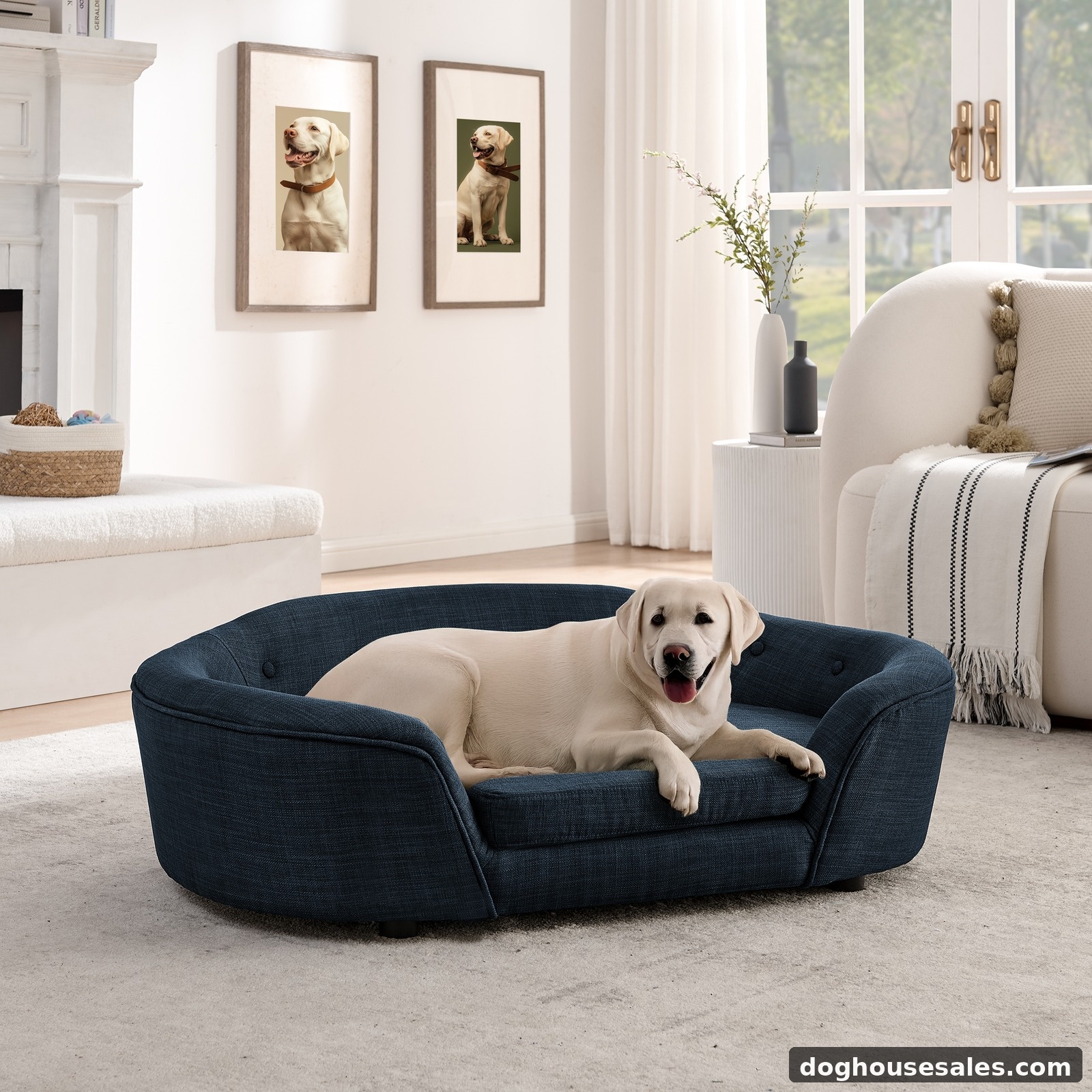
For a large dog that likes to sprawl, look at the width rather than the height of the bag: a 42 in wide chair gives a 40 lb dog room to lie flat, while a 27 in kids’ chair becomes a perch the dog slides off. If the dog is over about 70 lb, a flat foam sofa bed usually holds its shape better than beads do. Our foam dog sofa range and the oversized oval semi-enclosed dog sofa are built on that logic: a fixed foam core with a low rim the dog can lean against.

The safety issue nobody mentions: what is inside the bag
Bean bag safety is a filling-containment question. ASTM F1912-21 is a voluntary specification for bean bag chairs and covers that addresses hazards including access to or escape of filling, and it adds durability, zipper and labeling requirements. The U.S. Consumer Product Safety Commission’s reseller guidance states plainly that there is no mandatory U.S. standard for bean bag chairs, and describes the voluntary standard’s child-resistant closure and warning-label provisions.
Quotable: “ASTM F1912-21 is a voluntary specification for bean bag chairs and covers covering filling access and escape, closures, durability and labeling, while CPSC confirms there is no mandatory U.S. bean bag chair standard.” A compliant zipper is a child-safety feature; it is not a dog-chew feature.
That gap matters for dogs because a canine jaw is a seam test the standard never ran. A punctured cover releases hundreds of small beads that a dog can swallow, and the beads scatter into every corner of the room. Practical rules: keep a bead-filled chair out of a crate, out of a puppy’s reach when nobody is home, and inspect the seam and zipper monthly. If your dog has already opened a seam, the chair is done as dog furniture. A foam-core bed has nothing loose to spill.
Crates carry their own failure modes, and they are structural: a bent latch, a bowed wire panel, or a tray that slides out. Reviewers of crate ranges consistently flag frame and latch security as the things to check, and a divider panel is the feature that lets one crate grow with a puppy instead of being replaced twice.
Comfort, joints and senior dogs
This is the one category where the bean bag wins on paper. Beads and shredded foam conform to a dog’s body, so pressure lands on a broad area instead of on elbows and hips. Quotable: “Wirecutter’s long-term bean bag testing found some chairs too underfilled to support a sitter and others so overfilled they barely yielded.” A dog gets the same range of outcomes, minus the ability to complain about it. A dog gets the same range of outcomes from a human chair, minus the ability to say so.
A bean bag is also hard to get out of. For a senior dog with arthritis, hip dysplasia, or a neurological wobble, a deep, shifting surface is a trap: the paws sink, the surface moves, and the dog needs help standing. The better fit for that dog is a low, firm foam bed, ideally with a bolster to lean against. Our guide to rectangular vs round dog beds covers how shape affects how a dog settles, and it is the same reasoning that applies here.
For a healthy young dog that likes to drape itself over furniture, a large lounger is genuinely comfortable. The Giant Chair 5FT adult bean bag is the size class that works for a medium dog lying flat, though one reviewer noted a bag that large takes two people to move, which is worth knowing before it lands in a small room.
Cleaning, hair and smell
A crate with a removable tray is the easiest thing in the house to clean: lift the tray, wipe, replace the bedding, done. A soft crate adds a fabric shell that has to be washed whole.
A bean bag is the harder case, and owners say so. Hair and dander work into the weave, accidents soak into the fill, and the cover usually cannot be spot-cleaned effectively. Shared dog-and-human bean bag discussions raise exactly these points: punctures, trapped hair and dander, washable covers, and fill that compresses over time and needs topping up or fluffing. If you buy one anyway, insist on a removable, washable cover and treat a protective liner as part of the purchase, not an accessory.
If the chair will be shared, choose the model on cover construction rather than on colour. The XOCN human dog sofa bed is sold as a shared adult-and-pet seat, which is the honest version of what most people actually want: one piece of furniture both species use, with a cover you can wash.
Cost and floor space
Compare footprints, not just prices. A 36 x 24 in crate occupies about 6 sq ft of floor, and that footprint never changes. A 42 in bean bag is roughly 12 sq ft at rest and more once a dog has flattened it, and it has to sit away from radiators, sharp table corners and door swings. In a small apartment, the crate plus a thin pad uses less room than the chair the dog will claim anyway.
On cost, the pattern is consistent: a basic crate and a mid-size bean bag land in a similar band, but the crate is the one that replaces three other purchases (travel carrier, puppy pen divider, overnight bed). If you are furnishing from scratch, price the crate first and treat the lounger as the upgrade.
The setup that works: both, in this order
Most households do not need to choose. Put a dog crate or kennel in the room where the dog sleeps, sized from the chart above with 2-4 in (5.1-10.2 cm) of clearance, and add a thin flat pad rather than a thick bed that eats the head clearance. Then add an open lounger in the room where the family sits, and treat it as supervised furniture, not a bed.
Two placement rules do most of the work. First, the crate goes where people pass by, not in a bathroom or garage: a dog that can see the household uses the crate voluntarily. Second, the lounger goes against a wall or sofa arm so the dog can brace against something solid while it climbs on and off, which is the single biggest difference between a chair a dog uses and one it avoids.
If the crate is going to be visible, the furniture route is worth the extra cost. Our dog kennel end table guide covers load ratings and room fit, and the dog crate furniture guide walks through panel materials for anyone who wants the crate to read as a side table.
Where to compare crate and lounger options
Start on the containment side, then match it with a washable bed built for a dog rather than an adult bean bag.
- dog crates chosen by measured interior
- dog crate furniture
- heavy duty dog crates for chewers
- washable dog sofa beds
- all dog crate furniture
- all dog crates and kennels
Frequently asked questions
Is a bean bag chair safe for a dog to sleep on?
Only for short, supervised lounging. A bead-filled chair can be punctured, releasing small beads a dog may swallow, and no U.S. mandatory standard covers it. Check the zipper and seams monthly, keep it away from puppies and heavy chewers, and give the dog a proper bed or crate for overnight sleep.
Can a bean bag chair replace a dog crate?
No. A crate contains the dog, which is what housebreaking, travel, veterinary visits and chew management require. A bean bag has no door, no walls and no fixed interior, so it cannot keep a dog in one place or protect the house while you are out. Use the crate for containment and the chair for comfort.
What size crate does my dog need?
Measure nose-to-tail base length and standing height, then add 2-4 in (5.1-10.2 cm) to each and require at least 2 in (5.1 cm) of head clearance. A 36 x 24 x 26 in (91.4 x 61.0 x 66.0 cm) crate typically suits 41-70 lb (18.6-31.8 kg) dogs. Always check interior, not exterior, dimensions.
Can I put a dog bed inside a crate?
Yes, but keep it thin and flat. A thick orthopedic bed can push a standing dog’s head into the ceiling, cancelling the clearance the crate was sized for. A flat crate pad or a low mattress preserves the headroom, and a washable cover makes accidents easy to handle.
Which is better for a senior dog, a crate or a bean bag?
Neither, in most cases. A deep, shifting bean bag is hard for an arthritic dog to stand up from, and a crate is only a bed if it is padded. A low foam bed with a bolster to lean on, placed on flat flooring with a non-slip base, is easier on joints and easier to get out of.
Bottom line
The crate is the functional purchase and the bean bag is the comfort purchase. Size the crate from the interior dimensions and the dog’s own measurements, choose the lounger by footprint and washable cover, and never let one substitute for the other. If you are starting from nothing, buy the crate first: it is the only one of the two that can also be a bed, a travel box and a housebreaking tool.
Ready to set up? Browse furniture-style dog crates for the living room, and pair one with a foam dog sofa for the lounging spot. Every order ships free with no minimum purchase.
